

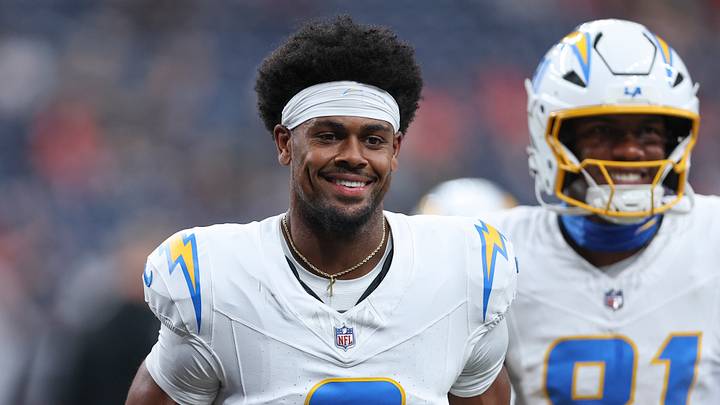
As much hype as there's been for the production of the Los Angeles Chargers' receiving corps under Mike McDaniel, the fact of the matter is that opportunities will be relatively limited—at least in terms of pure snap-share.
There should be many more explosive-play opportunities for pieces like Ladd McConkey and Quentin Johnston, both of whom have the speed and the elusiveness in the open field to take full advantage of McDaniel's YAC-dependent scheme. But while McDaniel employed multiple tight-end sets at a relatively low rate with the Miami Dolphins last season, the Chargers' additions of Charlie Kolar and David Njoku this offseason certainly make it seem like we're in line for a resurgence of the modern West-Coast staple in terms of personnel.
McDaniel will almost certainly lean into those sort of groupings, meaning that there will often be just two receivers on the field at any given time for Los Angeles. That doesn't mean that there will be a drop in production: only that there will be a greater competition to carve out major snaps in the course of the offense.
McConkey is set in his role out of the slot, and he should be the primary cog through which the air attack operates. But Tre' Harris could be the real wildcard here. If he's able to hold his own in three wide-receiver sets and begin to eat into Johnston's snap share as the team's primary X-receiver, we could see a rapid ascension for the second-year playmaker in 2026.
Tre' Harris has his work cut out for him, but there's still a path for him to be a major piece for this Chargers offense
Harris will find his way onto the field no matter what as a result of his blocking abilities. It's what helped keep him afloat in Greg Roman's scheme during his rookie campaign, and that's something that will likely translate into McDaniel's offense.
But Harris has much more to be unlocked as a pass catcher than what we saw last season. His rookie season wasn't entirely a dud—he posted 30 receptions for 324 yards and a touchdown—but he has the speed and the downfield catch abilities to be much more than that in a more cohesive and explosive passing offense.
As of now, Harris seems slated to be the starting Z-receiver for the Chargers when both Johnston and McConkey are also on the field. Given McDaniel's propensity for underneath, YAC-focused plays and deep crossers to take advantage of the defense, Harris should see a decent target share early in the season as the offense finds its footing.
But as much confidence as McDaniel has shown in Johnston's athletic abilities through training camp and the preseason, there's a real chance that Johnston's inconsistencies as a pass catcher open a door for Harris to slide into more of an X-receiver role as the season goes on. At 6'3" and 210 lbs, that seems to be where Harris can be best maximized—and his versatility out of the slot will only serve as a bonus in McDaniel's usage of him within the offense.
If Harris regresses at all in terms of his catch rate or doesn't show rapid improvement in the nuance of his route-running, perhaps he ultimately cedes snaps to weapons like Brenen Thompson and KeAndre Lambert-Smith. But if he's able to continue to build on the momentum he gained late last season, the early portions of this campaign (especially against the defenses the Chargers will face) could prove to be a test that Harris passes with flying colors.
No one (outside of Kimani Vidal perhaps) has more to gain or to lose over the first six or seven weeks for the Chargers offense than Harris. But knowing what we do about his intensity and continued improvement, it's reasonable to think he can be one of the team's biggest risers over the first portion of the regular season.
 Add us as a preferred source on Google