

The Los Angeles Chargers offense has been, plain and simple, the worst in the league to this point in the season. And that's saying something, considering the fact that the Tampa Bay Buccaneers won a game without completing a single pass last week.
As of now, the Chargers are dead last in the NFL in EPA/play by a wide margin, and there's only been a handful of moments this season where the offense has even looked viable—let alone capable of winning a game. It's going to take some major adjustments from Mike McDaniel to even come away with a singular win this season, and it's safe to assume, for now, that there's going to be a major overhaul this offseason on that side of the ball.
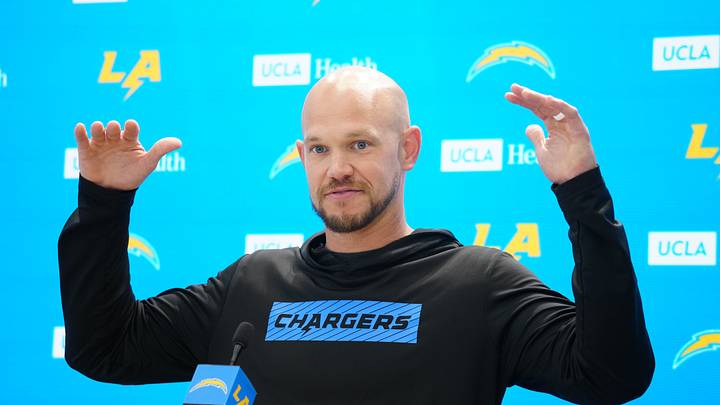
But barring a complete organizational reset, first-year defensive coordinator Chris O'Leary has done more than enough to keep his job intact. It was always going to be a tall task to fill the shoes of Jesse Minter, who put together dominant units in each of his two seasons in Los Angeles.
But O'Leary has overcome injuries and tailored his scheme to the current needs of the roster excellently, and the Chargers are now on track to put up another top-10 season even with an offense that has consistently put them in disadvantageous situations.
That's an impressive feat—and here are some of the numbers that have defined O'Leary's season so far.
5 statistical groupings that reflect Chris O'Leary's success in Year 1 with the Chargers
1. Blitz Rate: 27.0% (18th in NFL) & Sub Package Rate: 70.0% (14th in NFL)
These two statistics, at least on a surface-level basis, help us track the closeness of O'Leary's scheme to what Minter did with this unit over the past two seasons. Minter's defenses were consistently among some of the lowest-blitzing in the league, although he wasn't afraid to throw Daiyan Henley or Derwin James Jr. in the mix when the situation called for it. O'Leary blitzed a ton in his lone season at Western Michigan, so there's naturally been a slight uptick there for the Chargers—although O'Leary has played things rather conservatively at the NFL level.
The sub package rate is down significantly from last season, but that's likely a result of James' absence and the pure lack of depth Los Angeles has in the cornerback room. I don't see that as an identity change for this unit, but it is something worth monitoring if/when James returns this season.
2. Total Passing Yards Allowed: 1,339 (4th in NFL)
This is the most simple stat out of this list, but it's also the most immediately remarkable. After the first two weeks, when Cam Hart was getting targeted consistently and the Chargers defense was getting diced up by both Jacoby Brissett and Kirk Cousins, the outlook on this didn't look great. But O'Leary has managed to make major adjustments even being down one of his top quarterbacks in Donte Jackson, and although the scoreboard doesn't necessarily reflect it due to the offense's turnover issues, he's found a way to consistently limit opposing teams through the air. That was the hallmark of Minter's scheme, and it looks to be the hallmark of O'Leary's.
The Chiefs game stands out as a rough performance, but here's a breakdown of the passing yards this defense has allowed since that Week 2 matchup:
Week 3, Buffalo Bills: 174
Week 4, Seattle Seahawks: 148
Week 5, Denver Broncos: 118
Week 6, Kansas City Chiefs: 272
Week 7, Los Angeles Rams: 152
3. Interception Percentage: 3.06% (6th in NFL)
Takeaways, at least when you want to break down small differences in numbers, mostly come down to luck. But the Chargers have consistently forced teams to make errors (and capitalized upon them) with their various pre-snap rotations and zone shells. Although O'Leary has slightly shifted away from some of the complexities the team saw under Minter, these are the parts of a scheme that can make life harder on opposing quarterbacks, and O'Leary has managed to keep his defense in the best position possible over the course of this season.
4. EPA/Rush: -0.10 (13th in NFL)
Now we're getting to the room for improvement section of the data. As good as O'Leary's defense has been against the pass, it's only been middling against the run to this point in the season. The interior defensive line, at times, has struggled to fill gaps, but it's mostly been poor tackling by the inside linebackers and safeties that have led to the explosive ground plays for Los Angeles' opponents this year. Even in Week 8, a pair of poor angles by Elijah Molden on Rams runs resulted in major gains.
The Chargers are currently 17th in the league in total rushing yards allowed, and that number needs to be brought down steadily over the remainder of the season in order to relieve some of the pressure on the secondary.
5. Pressure Rate: 20.6% (24th in NFL) & Total Sacks: 12 (26th in NFL)
I think that, overall, O'Leary has done a solid job of finding ways to balance Khalil Mack, Tuli Tuipulotu, and Akheem Mesidor off the edge. But these numbers need to be a real consideration, especially as the team prepares for the possibility of losing Mack either at the trade deadline or in the offseason.
Tuipulotu is having a bit of a down year compared to his monstrous 2025 campaign, and Mesidor, although solid, hasn't made the same pure impact that Odafe Oweh did after his arrival. You don't need a league-leading pass rush in a zone-heavy scheme like O'Leary's, but one of Minter's trademarks was his ability to scheme up pressures as long as he had three truly viable pass rushers in the fold.
What happens if/when O'Leary has two? It's about the only major concern on this defense right now.
 Add us as a preferred source on Google