

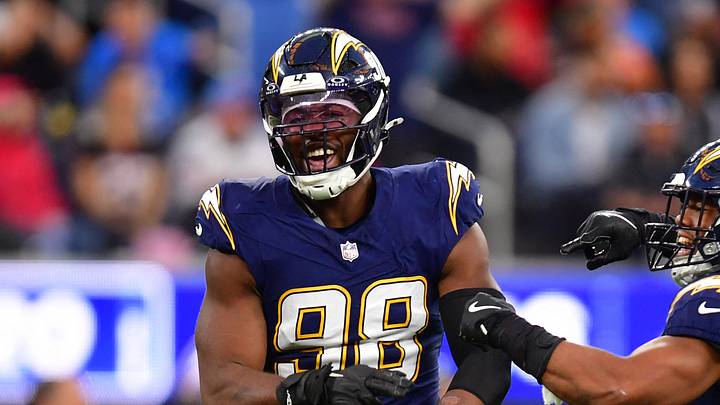
If there's one silver lining to be gleaned from the Los Angeles Chargers' disastrous, 0-4 start to this campaign, it's that the defense has managed to find its footing after the departure of Jesse Minter.
The injuries to Derwin James Jr. and Donte Jackson certainly haven't helped matters, but first-time play caller Chris O'Leary has managed to limit some highly effective opposing offenses in back-to-back weeks. Although he doesn't quite have the talent available in the secondary that Minter did currently, he's been able to leverage the Chargers' zone-heavy scheme in similar ways over the past two weeks. More importantly, he's found a balance between Khalil Mack, Tuli Tuipulotu, and Akheem Mesidor in the pass rush that should help keep the defense afloat over the course of the season.
A large part of Minter's success as Los Angeles' defensive coordinator was based on his ability to consistently dial up effective and varied pressure packages, and Oweh was a major part of that last season.
Although Mesidor doesn't have the same level of production that Oweh's posted with the Washington Commanders through four games, the rookie edge rusher has filled that complementary role to a tee so far—and he's doing it a much lower price point. As good as Oweh was when he was in Los Angeles, that's a trade-off that almost every team would take in a heartbeat.
Odafe Oweh is a good player—but the Chargers are better off for the foreseeable future with Akheem Mesidor on the roster
I'm about as big of an Oweh fan as you could find during his time in Los Angeles. He was the piece that, after his acquisition from the Baltimore Ravens, truly completed the Los Angeles defense, and his ability to consistently get pressure on the quarterback maximized both Mack and Tuipulotu's abilities over the course of the season.
But let's be realistic here. Oweh isn't a viable run defender, and his usage was primarily as a third edge rusher on clear passing downs to help free up opportunities for the rest of the defense. He finished the season with 7.5 sacks, but he was somewhat limited in his role by his lack of true run-defending abilities.
Oweh is getting paid just $9 million this season by the Washington Commanders after some cap maneuvering on his four-year, $96 million deal. But by the time both he and Mesidor reach the end of their current deals in 2029, he'll be getting paid $27.2 million. Mesidor, as the 22nd overall pick, will be earning just north of $6 million.
Sure, Oweh has outperformed Mesidor to this point in the season. He's posted 12 pressures and two sacks across four games, while Mesidor has posted six pressures and 1.5 sacks in that same span.
There's also the argument that, had the Chargers kept Oweh, they could've used that first-round pick differently. Perhaps KC Concepcion, Keylan Rutledge, Caleb Lomu, or even one of the second-round receivers in Denzel Boston and De'Zhaun Stribling would've been solid options.
But we're talking essentially a $20 million dollar difference over the next four years. Even assuming Oweh outpaces Mesidor by, say, 20 pressures over the rest of this season, is that sort of production worth that hefty price point? $20 million annually can pay for most of an extension for Tuli Tuipulotu. It can pay for a top interior lineman, or it can pay for another complementary receiver for the offense when the time comes.
There's more development in store, moreover, for Mesidor. Although he's already 25 years old, we've already seen him get more comfortable in his role and more effective attacking opposing pressure plans through the first four outings of his career.
With the cap commitments the Chargers have ahead of them, paying Oweh long-term simply wasn't an option. There's plenty of room to criticize Joe Hortiz and the rest of the front office's approach to the offseason, but this is a point where they were undeniably justified in their cap-saving approach.
 Add us as a preferred source on Google