

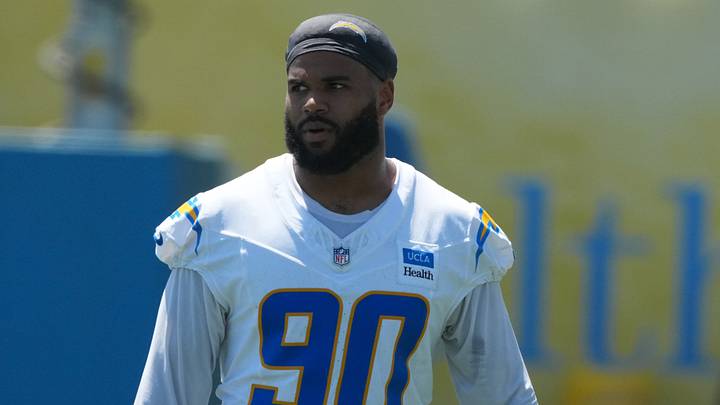
The Los Angeles Chargers saw some improvements on the defensive side of the ball in Week 3 against the Buffalo Bills.
Although their run defense was understandably sub-par, they managed to keep Josh Allen in the pocket and under pressure over the course of the matchup, holding the hottest offense in the league to 24 points and threatening to stop their momentum entirely in the first half. Of course, the offense fell short again.
But to see Chris O'Leary make these adjustments, at the very least, is a promising sign for this team's abilty to salvage their abysmal start to the campaign.
There are still questions lingering in the secondary that are highly concerning for the long-term viability of this unit. But any success O'Leary has found on his side of the ball, so far, has hinged upon pressure—both from the edge rushers and from the interior of the defensive line.
Although first-round selection Akheem Mesidor hasn't had the most jaw-dropping production so far in his rookie campaign, his presence and continued development serves as a hidden key to keeping that momentum going for the unit as a whole.
Akheem Mesidor needs to keep performing if the Chargers defense is going to keep their footing in 2026
Of course, part of what made Jesse Minter such an effective defensive play caller in Los Angeles was his ability to leverage matchups in the secondary and maximize the talent the Chargers had at cornerback. O'Leary has largely failed in that area so far, and the potential absence of Donte Jackson in Week 4 may blow the whole thing up entirely.
But a defense's coverage and its pass rush work in tandem, and O'Leary has found a way to replicate some of what Minter was able to accomplish on the latter front last season.
Mesidor was drafted with the intention of him replacing, if not Odafe Oweh's production, at the very least the tertiary pass rushing role that Oweh filled last season. Although Khalil Mack and Tuli Tuipulotu are both very active pass rushers, having a third player—and especially one who can line up on the interior when needed—is a necessary luxury in this type of scheme. That piece can draw attention away from the Chargers' primary edge rushers, and a truly athletic and powerful third pass rusher can open up Los Angeles' pressure package options exponentially.
In Week 1, it seemed like things simply weren't going to be good enough this season. Against a depleted Arizona Cardinals offensive line, the Chargers amassed just eight pressures—only three of which came from their trio of primary edge rushers.
But O'Leary made his adjustments in Week 2, and in Week 3 things looked even better. Los Angeles amassed 13 pressures against the Buffalo protection scheme, with Tuipulotu posting six and Mack posting three. Mesidor only put up a single pressure in that matchup (compared to his four against the Las Vegas Raiders). But he played 53% of the defensive snaps, and he was clearly active working off both the edge and interior.
There's still room for things to improve. The Chargers are in the middle of the pack in terms of pressure rate at a league-wide scale, and they were unable to threaten either Jacoby Brissett or Kirk Cousins at a sufficient level to truly derail those offenses.
But a significant justification for the Chargers' decision to draft Mesidor was his projected league-readiness and physicality immediately upon his arrival to the NFL. At the very least, he's provided that—and at a whole lot cheaper number than the four-year, $96 million deal Oweh earned with the Washington Commanders this offseason.
If he can continue to improve and find his footing over the next few games, we could be looking at a truly lethal pass rush unit by the time it's all said and done. Whether that will be enough to save the Chargers' season is another matter entirely.
 Add us as a preferred source on Google