

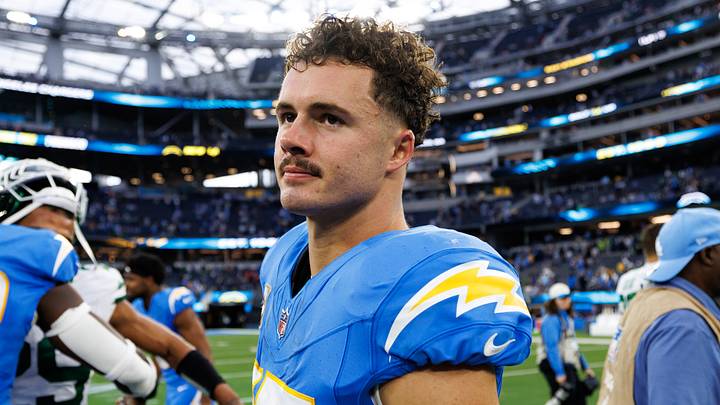
Fans of the Los Angeles Chargers, like almost every offseason, are going to enter the free-agent period in 2027 calling for a major addition to the offense. And if they've been justified for those demands in the past, this time they've been completely vindicated.
None of Ladd McConkey, Quentin Johnston, or Tre' Harris have taken the leaps that were expected under Mike McDaniel. McConkey has struggled with injuries over the course of this season. Harris and Johnston have struggled to earn separation in the deeper parts of the field, and when the ball has come to them, they've been inconsistent at the catch point.
Adding a true alpha in this room needs to be a priority for Los Angeles, whether that comes through free agency or in the form of Jeremiah Smith or Charlie Becker near the top of the 2027 NFL Draft. If the Chargers are hoping to put forward a viable offense in 2027, it's simply a non-negotiable.
But that need extends beyond even the immediate demands of the offense. With extension negotiations looming for McConkey as soon as this offseason, the Chargers need to get a real look at what he can be in a properly-defined role.
That requires cementing him as the no. 2 option for the offense—not the alpha for the room out of the slot.
Ladd McConkey needs to be properly evaluated before the Chargers are able to levy a major extension
Now, it's not hard to see a world where McConkey is among the league's most dynamic slot receivers—and his ability to line up in any of the three receiver spots is a bonus in that regard. In his rookie season, when he operated as the Chargers' primary pass catcher, he was able to amass 82 receptions for 1,149 yards and seven touchdowns. Those, at the time, seemed like the numbers of a future top receiver.
But the return of Keenan Allen in 2025 took away many of those big-play opportunities from McConkey. His target share ultimately didn't drop that much—from 112 in 2024 to 106 in 2025—but his pure receptions and overall production saw a relatively significant decline. When he's been available in 2026, he's been just about the only consistent pass-catching option for this anemic offense, posting 22 receptions for 323 yards across five full games.
But let's be realistic here. McConkey is still a more than solid option for this offense, especially in the middle of the field, but he's not dominating other team's best corners on the outside and going up for tough, contested catches on deep throws from Herbert. At his size and stature, he's better suited long-term as a complementary underneath receiver next to a player who is capable of those things.
McConkey hasn't had that to this point in his career, and Los Angeles is just one year away from potentially having to shell out another major cap hit to a player who hasn't fully proven himself as a consistent offensive option in his proper role. There's an argument to be made, in fact, that McConkey could be more productive as a complementary option in that context—the strain that a top X-receiver would put on opposing defenses could allow him more opportunities underneath to utilize his speed and agility.
That also applies to the rest of the receiver room. Having a true alpha in place would allow both Johnston and Harris to work primarily off of opposing team's secondary cornerbacks, working both into more natural Z-receiver roles and making it easier for them to gain the separation Los Angeles has so sorely lacked in McDaniel's scheme.
Both Smith and Becker project to be that sort of player. And if McConkey can stay healthy for most of 2027 while playing productively next to one of them, an extension will be more than warranted.
Right now, though, the Chargers haven't seen enough to fully trust McConkey as the future primary playmaker of this room. And that's only another reason why the urgency should be on this offseason to rectify the shape of this room.
 Add us as a preferred source on Google