

Even with a win in Week 10 against the Baltimore Ravens, the Los Angeles Chargers are still very much in play for the first overall pick.
Sure, their schedule gets significantly easier in the coming weeks. Matchups against the New York Jets, Drake Maye-less New England Patriots, Tampa Bay Buccaneers, and Miami Dolphins are looming. And even if the Chargers make their way out of that slate with just two more wins, a three-win record still puts them in danger of falling to the second or third overall pick when it's all said and done.
But right now, the Chargers are tied for the fewest wins in the league with the Tennessee Titans and the Dolphins. And until it becomes clear that won't be the case at season's end, it's worth discussing what Los Angeles does if it ends up with the first overall pick.
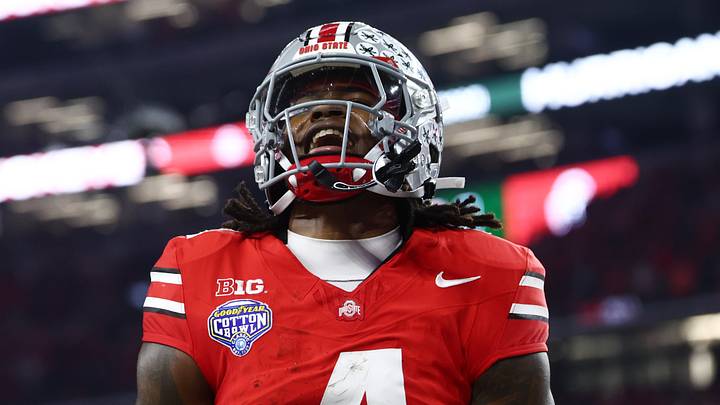
Jeremiah Smith is the obvious choice there for a non-QB needy team. He's displayed an elite combination of speed, route-running, explosiveness, and catch-point versatility in his three seasons at Ohio State, and the Chargers' greatest need on their roster, currently, is for an alpha receiver that can help the offense reinvigorate its structure in 2027 and beyond.
But according to Adam Schefter, there is a belief that, if either the Titans or the Chargers end up with the first overall pick, there would be an immediate bidding war for the right to select Oklahoma State QB Drew Mestemaker.
There's arguments to be made on both sides for Los Angeles. But no matter what ultimately happens, the first overall pick may very well be the final real inflection point for a regime desperately attempting to justify its jobs this offseason.
The Chargers could certainly use Jeremiah Smith—but is a bidding war a viable option there?
Let's start by simply gaming out the scenarios here if the Chargers somehow wind up with the first overall pick come April.
Option one—simply take Smith. Even with Quentin Johnston on the payroll for $16.5 million next season, it's become more than clear that the Chargers don't have enough in the way of pass catching to put together a Super Bowl-worthy offense. Even if Mike McDaniel's scheme had been implemented to perfection, leading to leaps for all three of Johnston, Ladd McConkey, and Tre' Harris, there would still be plenty of room to argue that Los Angeles is in dire need of a true X-receiver.
For most people, Smith is a generational prospect—not one that can be passed up for the sake of an extra pick, even if it comes inside the top-10. I'd be inclined to agree with that sentiment.
But there's still option two, and it seems to be the one that Schefter views as most likely if either Tennessee or Los Angeles ends up with that sort of draft capital. Even in a relatively weak QB class, there are going to be teams desperate to find some sort of future swing at the position—in fact, the lack of depth in this class might only serve to increase that desperation from teams at the top of the board. Schefter lists the New York Jets, Arizona Cardinals, and even the Cleveland Browns as examples of teams that could be willing to make that move.
With the way the board is laid out right now, the Jets seem to be the team with the most logical path toward swinging that sort of deal. They're currently in possession of the fourth overall pick (their own) and the sixth overall pick (which they received from the Indianapolis Colts in the Sauce Gardner deal). If they were enamored with Mestemaker, and felt like the Cardinals (at third overall) were a real threat to swipe him off the board, perhaps they'd be willing to package those top two picks and leapfrog their primary competitor. Perhaps the no. 13 selection, which also belongs the Jets, is in play there instead of the sixth.
With the fourth and either the sixth or 13th overall selections, Los Angeles could easily grab the second-best receiver in the draft, Indiana's Charlie Becker, while nabbing a top interior lineman like Trevor Lauck out of Iowa. Although Becker isn't on the same level as Smith in terms of future upside, he still presents the X-receiver skill set that Los Angeles desperately needs, and he has the height and the open-field explosiveness to still be an immediate upgrade to the Chargers' receiving corps. Lauck, meanwhile, would fill an immediate need for Los Angeles as well, filling either the right or left guard spot from essentially Day 1 in the NFL.
Those are both very strong options to consider, but that's not really the point here.
The point is that Joe Hortiz and Jim Harbaugh, if they're not let go this offseason, are going to need to find a way to turn this roster around for 2027. And no matter where they land in the draft, the types of moves they make on draft night and the selections they ultimately come away with will play a large part in either preserving their jobs or damaging them even further. Knowing this regime, it will go with whatever it perceives as the 'safe' option, whether that's to hold in place and select Smith or maximize their draft capital when they have the opportunity.
What's at stake for the Chargers, then, in the race for the first overall pick and the subsequent 'bidding war' that Schefter projects is more than just an elite wide receiver prospect. This year's draft will be an inflection point for the organization as we know it, and the future of the team, then, is what's at stake—especially if Los Angeles winds up with the first overall selection.
 Add us as a preferred source on Google