

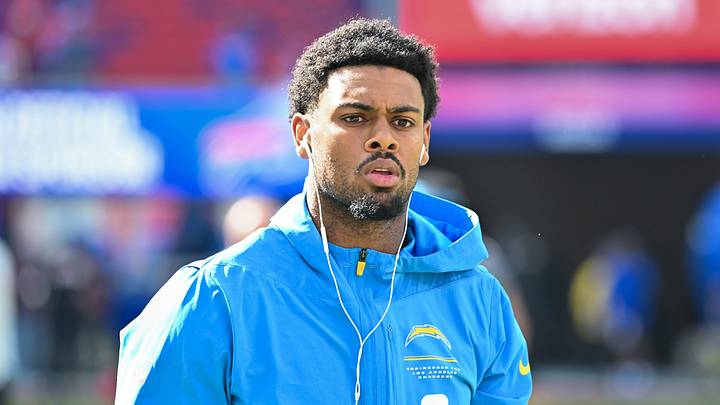
By the end of their Week 5 matchup, the Los Angeles Chargers were essentially running on fumes on offense. Not only were they playing four rookies along their offensive line, but by the end of the game, all three of their primary wide receivers were sidelined as well.
Tre' Harris was the only one that entered the game fully healthy—with Quentin Johnston out with a chest injury and Ladd McConkey available on an emergency basis due to an issue with his foot. But after Harris exited the game with a hamstring ailment, the Chargers were left trying to make things work with the likes of Marques Valdez-Scantling and Theo Wease Jr.
If that's the case again in Week 6, you can essentially write this next matchup off as well. With McConkey having been significantly limited this season by injuries, Harris has emerged as the Chargers' real playmaker through the air, posting 15 receptions for 225 yards across five games.
Jim Harbaugh has said that Harris is "week-to-week" with the injury he suffered in Week 5. He did not practice on Tuesday as the Chargers prepared for their matchup with the Kansas City Chiefs.
Obviously, that's a problem in the short-term for the Los Angeles offense. But as the front office attempts to sort out the future of this roster—and especially the wide receiver room—Harris missing any time at all leaves more uncertainty than they would likely bargain for.
If the Chargers are going to attempt to move on from Quentin Johnston in any shape or form, they'll likely need some form of assurance that Harris can reliably function, at the very least, as a complementary X-receiver moving forward.
The Chargers need to see further flashes out of Tre' Harris if they're going to strip down this offense
First and foremost, I'm not convinced that moving Johnston will even be an option at the trade deadline. His first-round pedigree should, theoretically, draw some interest across the league. But Los Angeles has already picked up the fifth-year option on his rookie deal, meaning that any team that trades for him would be responsible for his $16.5 million salary for 2027. He hasn't produced to this point in the season, and he's still limited with a chest injury right now.
Maybe there's a fifth or sixth-round pick somewhere out there for the Chargers. If there is, it's hard to know whether they'd even entertain that offer. They've certainly valued Johnston more highly than that in the past.
But even if Los Angeles is going to tear down this roster, to an extent, at the trade deadline, this still isn't a rebuilding team. With over $58 million owed to Justin Herbert next season, the Chargers are going to do everything within their power (or within their conservative decision-making process) to help this roster return to competitive status. They likely won't be moving on from Johnston without a concrete plan to round out the receiving corps.
Of course, if the Chargers end up with a top pick in the Draft, they would likely be able to add a player like Jeremiah Smith (fingers crossed) or Charlie Becker—both X-receivers who could serve as perfect alphas next to McConkey. But betting the future of the receiving corps on that sort of development, at least right now, doesn't seem like something that's in character for Hortiz.
It's also important to remember that much of what Harris has shown as a primary receiving option is simply theoretical to this point in his career. He worked his way onto the field in Greg Roman's scheme because of his blocking abilities, but he posted just 30 receptions for 324 yards over the duration of 2025. A large chunk of his yards this season, meanwhile, have come on just a handful of explosive plays.
Beyond that, though, it's simply been difficult to evaluate the true upside of the receiving corps with the way this offense has played to this point in the season. If Harris is week-to-week, with only three games remaining for the Chargers between now and the trade deadline, it makes that task nearly impossible.
Los Angeles' potential willingness to move Johnston certainly won't hinge entirely on its hopes for Harris, but the two things are likely related as the organization explores their pathways to turning this roster around in the long-term.
 Add us as a preferred source on Google