

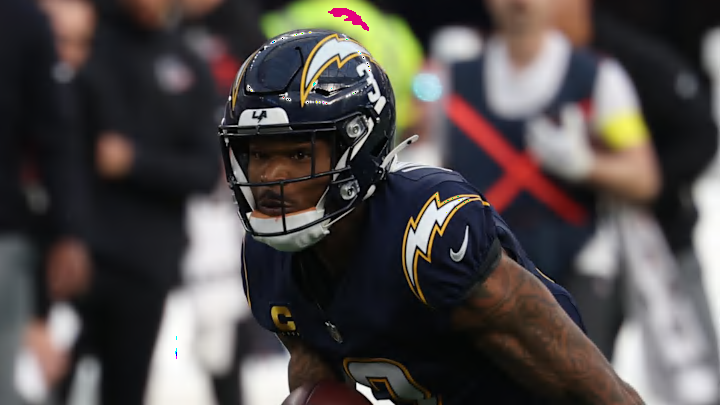
Derwin James has seemingly overcome the injury issues that plagued the earlier parts of his career. After missing most of 2019 and all of 2020, James has played 77 games over the past five seasons. In that time, he has made four Pro Bowls and been named first or second team All-Pro just as many times, including this past year.
James is now entering the final year of his four-year, $76 million contract that is set to pay him $17.5 million per year. James signed that deal in 2022 and is still the fourth-highest paid safety in the NFL as measured by APY. But given his history with physical ailments, it makes sense that he and his representatives would be looking for an extension ahead of his contract year.
Derwin James' value
James is coming off of a stellar two-year stretch. In my research, it is this time frame that has the best correlation to contract value. In that time, he has a weighted Pro Football Focus grade of 80.9 with an 80.4 coverage grade. He has four interceptions and four pass breakups while recording 180 tackles, 66 stops, 22 splash plays (tackles for loss + sacks + forced fumbles), while missing less than 10% of his tackle attempts. That's a fantastic resume. Here is how James compares to a couple of other 30+ safeties who signed contracts since 2020.
I wanted to control for two things: age and skill/reputation. I found Kevin Byard (2023), Harrison Smith (2021) and Devin McCourty (2020). Here is how James stacks up against those three.
Player | Age | Weighted PFF DEF Grade | Weighted PFF Cov Grade | INT | PBU | Tackles | Stops | Splash Plays | MT Rate |
|---|---|---|---|---|---|---|---|---|---|
Derwin James (2024 - 2025) | 30.1 | 80.9 | 80.4 | 4 | 4 | 180 | 66 | 22 | 9.1% |
Kevin Byard (2021 - 2022) | 30.0 | 83.8 | 84.9 | 9 | 8 | 186 | 34 | 3 | 5.1% |
Harrison Smith (2019 - 2020) | 32.6 | 80.5 | 82.6 | 8 | 11 | 171 | 35 | 8 | 10.9% |
Devin McCourty (2018 - 2019) | 33.1 | 79.8 | 85.5 | 6 | 3 | 119 | 24 | 6 | 9.2% |
James has the worst ball production of the group, but the best splash plays that typically occur behind the line of scrimmage. It represents a different way to impact the game and create turnovers with explosive plays on defense.
Byard and McCourty signed extremely similar deals when looking at their APY's as a percent of the salary cap. Byard's $12.55 million APY was 5.6% of the 2023 salary cap and McCourty's $11.5 million salary was 5.8% of the 2020 salary cap.
Smith was a bit of a specific case. His $16 million APY was 8.8% of the $182.5 million salary cap in 2021. But that cap number was depressed due to the effects of Covid-19. I have found that stabilizing that number to the midpoint of the 2020 and 2022 salary caps - $203.2 million - creates a truer picture of how teams felt about players who were signed that year. That adjusts his APY as a percent of cap to 7.87%
Byard and McCourty represent the floor for any ask. Cap-adjusting their deals basically equates to James' 2026 salary at $17.5 million. Smith is the ceiling. His cap-adjusted contract would be $23.7 million. I think James would struggle to match his deal. But the average of the three would be $19.33 million. Over three years that's $58 million. James could also get a slight bump for his accolades.
That's why I think $20 million APY on a three-year deal - $60 million total - is the sweet spot. This would keep him at the fourth highest paid safety in the game while bumping his APY a small bit. His total effective APY, including his current year and cash owed would come in at $19.375 million.
Structure and cash flows
A guaranteed structure on the new money of just a bit over 60% would be $37 million. Combined with the $3 million he is already guaranteed for this year would be a total of $40 million. The Chargers would set those guarantees for 2026 and 2027 with $20 million cash flows for each year. That would leave an $18 million cash flow for 2028 and $19 million for 2029.
The Chargers have plenty of contract space, so they don't need to change around the structure of James' 2026 cash flow to create additional space. Reducing James' base salary by $1 million this year but adding a $3.5 million signing bonus helps get him to the $20 million cash flow for this year while reducing his cap hit by just $125k this year. The whole of his contract would break out like this:
Year | Cash Flow | Base Salary | Prorated Bonus | Roster Bonus | Guaranteed Salary | Cap Number | Dead Cap | Cap Savings |
|---|---|---|---|---|---|---|---|---|
2026 | $20,000,000 | $13,500,000 | $7,981,495 | $3,000,000 | $20,000,000 | $24,481,495 | $47,106,495 | ($22,625,000) |
2027 | $20,000,000 | $15,000,000 | $875,000 | $5,000,000 | $20,000,000 | $20,875,000 | $29,625,000 | ($8,750,000) |
2028 | $18,000,000 | $15,000,000 | $875,000 | $3,000,000 | $0 | $18,875,000 | $1,750,000 | $17,125,000 |
2029 | $19,000,000 | $15,000,000 | $875,000 | $4,000,000 | $ 0 | $19,875,000 | $875,000 | $19,000,000 |
 Add us as a preferred source on Google