

Water is wet, the sun rises in the East, and the LA Chargers have a bad offensive line. There are certain fundamental truths that the universe relies upon, and a patchwork Chargers offensive line is one of them.
Los Angeles reached yet another disgusting low with its offensive line in Week 4. Both starting tackles were knocked out of the game and the paltry interior offensive line was beaten up even more. As bad as the 2025 season was for the offensive line, the product on the field against the Seattle Seahawks may have been worse.
This turnstile offensive line is upsetting for a myriad of reasons, but mostly because of what could have been possible over the offseason. General manager Joe Hortiz cheaped out on making real additions and whiffed on the players he brought back from last year's squad.
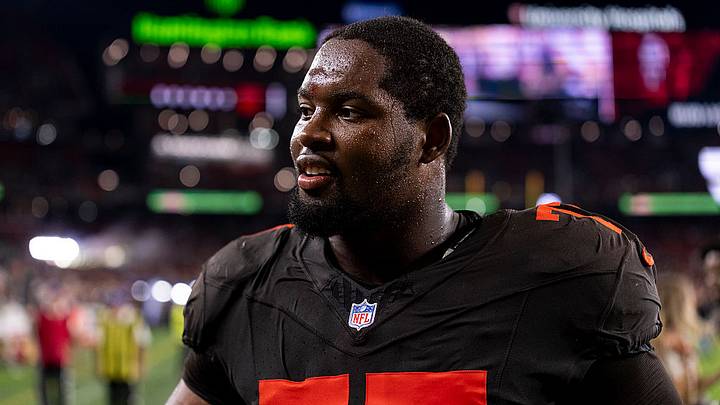
Hortiz let 2022 first-round pick Zion Johnson walk to the Cleveland Browns after previously rejecting his fifth-year option. It's taken Johnson just four games to make Hortiz eat crow for that decision.
Zion Johnson has done what no Chargers guard has done this year
Johnson has been great as a pass protector for Deshaun Watson thus far this year. He ranks 10th among all guards in pass-blocking grade on Pro Football Focus and has two games already with zero pressures allowed. While his run blocking could use some work, Johnson has only allowed three pressures in 151 pass-blocking snaps this season.
That gives Johnson a pass-blocking efficiency (EFF) of 98.9. He ranks seventh among the 63 guards with at least 80 pass-blocking snaps this offseason.
Zion Johnson's EFF compared to Chargers guards:
Player | EFF |
|---|---|
Zion Johnson | 98.9 (151 snaps) |
Kayode Awosika | 97.8 (48 snaps) |
Cole Strange | 96.9 (159 snaps) |
Trevor Penning | 94.7 (84 snaps) |
Trey Pipkins | 91.7 (14 snaps) |
Strange and Penning rank 35th and 62nd, respectively, on the same list of guards. No Chargers guard has multiple games with zero pressures allowed this season. Worst of all, Johnson is doing it all on an affordable price point. His three-year, $49.5 million contract breaks down favorably for the Browns.
Johnson carries a cap hit of $5.1 million in 2026 and $7.7 million in 2027. It jumps to $13.1 million in 2028 with a void year in 2029 that will only cost the Browns $6 million. Johnson's contract was more than manageable for the Chargers to replicate. Instead, Hortiz paid Strange and Penning a combined $8.75 million on the cap this season to be mediocre.
Zion Johnson isn't the only Browns offensive lineman that should be a Charger
The worst part is that the Browns' success doesn't stop at Johnson. Somehow, some way, the Chargers were outclassed by an organization that has been the definition of dysfunctional over the last three decades. That's how poorly this was handled.
Playing center alongside Johnson is Elgton Jenkins. Jenkins made all the sense in the world for the Chargers as a veteran guard/center option who fit the scheme and gave the Chargers positional versatility. So what did the Chargers do? Absolutely nothing, allowing Jenkins to sign with the Browns on a two-year, $24 million contract.
The Chargers were reportedly interested in Jenkins, and it doesn't take a rocket scientist to read between the lines and guess why he is in Cleveland instead of Los Angeles. Hortiz probably didn't budge from his price, allowing a great offensive lineman to get away.
Jenkins has made Hortiz eat crow since. The veteran lineman has allowed just one pressure in 113 pass-blocking snaps this season. Sure, he missed Week 4 with an injury, but it's not severe and certainly not any worse than what the Chargers have dealt with.
The Browns have the interior offensive line the Chargers could have had. There's reason to believe it would have been even more effective in LA, too, given the two All-Pro-caliber tackles the Chargers have on the outside.
Throw in a high draft pick at guard (heck, it could've still been Jake Slaughter!) and suddenly the Chargers' offensive line goes from hopeful with minimal depth to one of the best in the league. But instead, the Chargers are stuck with whatever version of the offensive line Hortiz threw together so he could save a buck.
The worst part? The Chargers still have $27.5 million in cap space. Hortiz could have made the exact same moves during the offseason and still had just under $20 million in cap space for the regular season with Johnson and Jenkins on the roster.
 Add us as a preferred source on Google