

The Los Angeles Chargers were always going to need a major performance out of their defense if they were going to come away with a win at any point this season. In Week 10 against the Baltimore Ravens, they got one.
Of course, things weren't perfect. The secondary struggled to limit the Ravens' Jacoby Brissett-led passing game in the second half, ultimately allowing the quarterback to complete 33 of his 49 passing attempts for 340 yards. But to their credit, they limited Baltimore in the red zone (Brissett threw zero touchdowns and one interception on the day), and the real strength of their defensive effort came against the run.
Derrick Henry, who's struggled to put up major numbers since Lamar Jackson went down, finished the day with just 10 carries for 10 yards. And the credit for that, largely, falls upon the defensive line.
Although Justin Eboigbe was inactive, all of Teair Tart, Dalvin Tomlinson, Jamaree Caldwell, and Nick Barrett had highly impressive performances, and Tart, in particular, issued a poignant reminder in this matchup.
Even with the depth Los Angeles has in that room, he's worth every penny of the three-year, $30 million extension the organization furnished him with this past offseason.
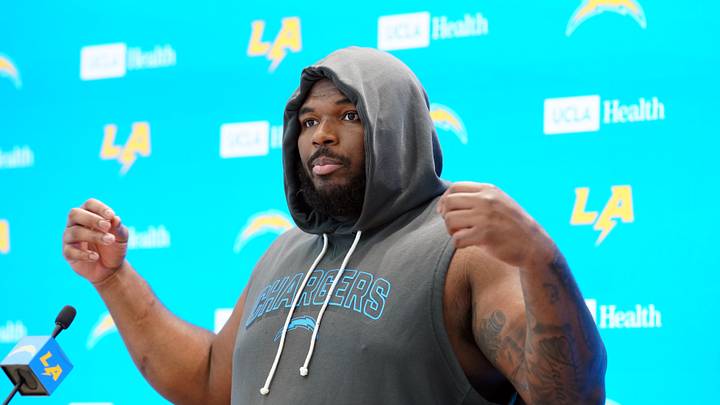
Teair Tart is rapidly becoming a cornerstone of Chris O'Leary's defense
Under Joe Hortiz, the Chargers have generally been willing to cycle out talent on the defensive side of the ball. They let Benjamin St-Juste walk this past offseason without finding a direct replacement, and they let Poona Ford walk to the Los Angeles Rams the offseason before that for a contract similar to what Tart ultimately got.
We can talk about the merits or drawbacks of those decisions all day—but to Hortiz's credit, he managed to bring Tart back on a relatively modest deal after a season where the former UDFA established himself as easily the most dominant presence along the Chargers' defensive line. Three years and $30 million puts him in the same territory of annual salary as the Cleveland Browns' former first-round pick Mason Graham and the Houston Texans' veteran defender Sheldon Rankins.
Now, Tart hasn't outperformed either of those players in terms of pure production this season. Graham has 16 pressures across his first eight games of this campaign (although his tackling remains somewhat inconsistent against the run), and Rankins has an absolutely absurd 29 pressures across his first nine appearances.
But Tart's impact on the interior for the Chargers has been immeasurable by basic production metrics. His ability to consistently generate pressure while taking on wider alignments has allowed defensive coordinator Chris O'Leary to truly shuffle things along the defensive line, which was his stated intention coming into this season. And with the lack of pure, passive pressure the Chargers have gotten from their edge rushers this year, that's an invaluable tool to have.
Sure, Tart likely won't ever play a major role as a run defender—although, as we saw in Week 10, he's more than capable of doing it on limited reps. But his primary value comes in the way he helps crystallize the hierarchy of the room.
His presence as a pass rusher makes life easier on both Tomlinson and Caldwell on those reps, and his pure, downhill strength and intensity, along with O'Leary's willingness to leverage him in the pass rush, means there always has to be some sort of focus on him in the opponents' protection scheme.
His three-pressure outing against Baltimore was simply a reminder of that fact, and if Eboigbe and Caldwell can continue to grow over the next couple of seasons, this room will continue to be a strength of the Chargers defense.
 Add us as a preferred source on Google