

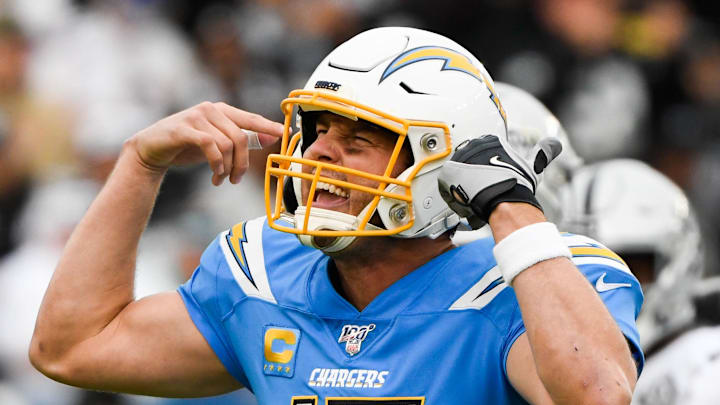
The NFL staff at Bleacher Report dropped its annual ranking of the top 99 quarterbacks in NFL history this week, and the Los Angeles Chargers were well-represented on the list, as nine signal-callers on the list suited up for the Bolts at some point in their respective careers.
Most, of course, made their way onto the list due to the success they had elsewhere, but Chargers fans will certainly recognize a few franchise legends.
- No. 93, Justin Herbert: Current Chargers QB
- No. 90, Jim Everett: Played four games for the Bolts in 1997, his final NFL season
- No. 81, Jim McMahon: Started 11 games for the Chargers in 1989, going 4-7
- No. 62, John Hadl: Played 11 seasons with the Bolts (1962-1972); ranks third in franchise history in passing yards and TD passes
- No. 60, Jack Kemp: First starting QB in Chargers history; played parts of three seasons with the team (1960-1962)
- No. 23, Dan Fouts: Played his entire 15-year career with the Bolts (1973-1987); ranks second in franchise history in passing yards and TD passes
- No. 11, Johnny Unitas: Played the last of his 18 NFL seasons with the Chargers in 1973
- No. 8, Drew Brees: Played five seasons with the Bolts (2001-2005)
You'll notice, of course, that we only listed eight of the nine. And the reason for that is because our main focus here is Philip Rivers, who landed at No. 32.
Now, there's certainly no shame in being considered one of the top 32 quarterbacks of all time, but seeing as how he ranks 22nd all-time in completion percentage (64.9), eighth all-time in passing yards (63,984), and sixth all-time in touchdown passes (425), there's certainly an argument to be had that he should be ranked higher.
That said, it's pretty clear why he wasn't.
Philip Rivers' lack of a Super Bowl win (or appearance) clearly hindered his all-time QB ranking
This certainly isn't meant to insult any of the 31 quarterbacks placed ahead of Rivers in the rankings, and we won't sit here and compare him with every single one of them. We will, however, take a quick look at the two quarterbacks with whom he's often linked to, those being Ben Roethlisberger and Eli Manning, as all three were taken in the 2004 draft.
The Chargers, of course, took Manning at No. 1 overall, but as he refused to ever take a single snap with the Bolts, they made a deal to send him to the New York Giants, who took Rivers at No. 4. Roethlisberger then went to the Pittsburgh Steelers at No. 11.
All three had lengthy careers, and all three put up monster numbers, which we've included below. It should be noted that outside of the bottom line, only regular-season statistics and accolades are featured here.
Stat | Philip Rivers | Ben Roethlisberger | Eli Manning |
|---|---|---|---|
Seasons | 18 | 18 | 16 |
Games/Starts | 247/243 | 249/247 | 236/234 |
Record | 134-109 | 165-81-1 | 117-117 |
Win Pct. | .551 | .670 | .500 |
Comp. Pct. | 64.9 | 64.4 | 60.3 |
Pass Yards | 63,984 | 64,088 | 57,023 |
Pass TD | 425 | 418 | 366 |
Interceptions | 212 | 211 | 244 |
Passer Rating | 95.0 | 93.5 | 84.1 |
Pro Bowls | 8 | 6 | 4 |
Super Bowl Wins | 0 | 2 | 2 |
In case you haven't figured it out by now, the two others were both ranked ahead of Rivers, with Roethlisberger coming in at No. 16 and Manning landing at No. 24. And it's pretty easy to understand why, as both won a pair of Super Bowls, while Rivers never even made an appearance, coming closest with an AFC Championship Game appearance during the 2007 season, where the Chargers took a 21-12 loss to Tom Brady and the undefeated New England Patriots.
Manning's Giants, of course, pulled off the greatest upset of all time by taking down the Pats in Super Bowl 42. Eli & Co. again upset New England four years later. And those two wins are the only reason he's ranked ahead of Rivers.
And make no mistake about it; those victories were undoubtedly impressive. But from a pure talent perspective, is Manning a better quarterback than Rivers? No, he's not. It's certainly much closer when it comes to Roethlisberger, which the stats shown above clearly indicate, as the two had eerily identical numbers.
Now, one could reasonably ask why Fouts, who never won a Super Bowl either, was placed ahead of Manning. And the reason there seems to be that B/R specifically stated that they gave out "bonus points for trend-setters and mold-breakers," and as Fouts helped shape the NFL into more of a passing league by becoming the first ever to throw for 4,000 yards in consecutive seasons, he clearly benefitted from those bonus points.
But as they probably should be, championships shaped the top of the list, as only two of the top 20 never won a title, those being Fran Tarkenton (No. 13) and Dan Marino (No. 10).
That said, the statement was also made that "while stats and awards matter, sometimes sheer talent transcends all that." And based on that, seeing as how Rivers had stats and certainly had talent, more than plenty of players ahead of him, we're just thinking that 32nd just wasn't high enough.
 Add us as a preferred source on Google