

The tale is as old as time. With $100 million in cap space this past offseason—and a mandate to re-structure one of the most disastrous interior offensive lines in the league from 2025—the Los Angeles Chargers instead opted to bring in budget options at both guard spots.
They gave Cole Strange unimpeded access to the starting right guard spot at the price of $13 million over two years, while setting the stage for a competition between second-round pick Jake Slaughter and career backups Kayode Awosika and Trey Pipkins III for the left guard spot. For depth beyond that? They spent their pair of sixth-round picks on a pair of college tackles that they identified as guards on draft day.
Then Tyler Biadasz went down, and Slaughter was shifted over to starting center responsibilities halfway through the preseason. Then both Awosika and Pipkins got hurt in the first two weeks of the season. So did Trevor Penning, who the Chargers acquired at last year's trade deadline and re-signed to a one-year deal in the offseason.
You know the rest.
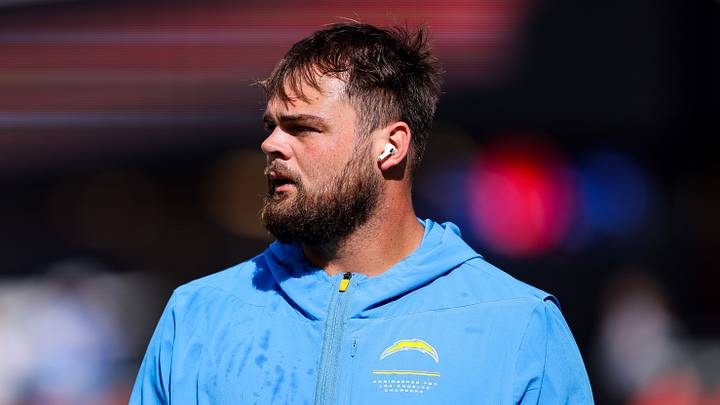
But if there's one silver lining that's come out of this recent stretch of thinned-out protection for Los Angeles, it's been the emergence of one of those sixth-round selections, Logan Taylor, as a true option at left guard. Across six games as a true starter, he's been about as pleasant a surprise as you could possibly expect given his draft position and experience at guard.
The Chargers, though, can't consider that to be a true solution moving forward.
The Chargers still need to overhaul this interior O-line this offseason—Logan Taylor has simply earned his place in the competition
Again, Taylor has been about as strong as you could expect a sixth-round rookie to be in the position he's been thrust into, especially in the run game. Across those six starts, he's allowed just nine pressures on 247 pass-blocking snaps, and although his moments in the run game haven't all been highlights, he's made a difference there as well as the Chargers have leaned more heavily into Omarion Hampton as their lead back.
Awosika's return from injury, and him stepping in for Strange at the right guard spot in Week 11, present some intrigue as well over the remainder of the season. If Travis Burke can continue to improve at right tackle, perhaps Los Angeles has a chance to keep Justin Herbert relatively clean over the rest of this campaign.
The rest of this campaign, though, needs to be the key phrase there.
The Chargers will enter this offseason with close to $100 million in cap space again, with room for variance there depending on how things unfold. An expected Tuli Tuipulotu extension would put them at around $75 million—and unless the front office goes out and splurges on a major skill weapon for the offense, the vast majority of that money should go to the interior offensive line and the holes remaining along the defense.
Quenton Nelson will be the top target this offseason. Although he was traded to the Seattle Seahawks at the deadline, and that team is likely to make a bid to re-sign him this offseason, that remains far from a guarantee. He's not the only free-agent option, though, to shore up the Chargers' interior.
Kevin Dotson, who's had a pair of excellent seasons on the interior of the Los Angeles Rams' offensive line, should hit the open market as well. Although Tyler Steen has been relatively consistent in the Philadelphia Eagles' protection scheme over the past two seasons, he's a conceivable option as well. And there are first-round players, like Trevor Lauck out of Iowa, that Los Angeles could land through a draft-day trade.
So Taylor has been good—and that's a promising sign. But that doesn't mean he should have anything other than a steep path to earning either of the starting guard spots for Los Angeles next season. They need to sign a true, veteran free agent for the interior—leveraging the cap savings from moving off of Strange's contract to give that player perhaps an above market-value deal. If one of the guard spots is actually sorted, then there's room for a competition on the other side.
Perhaps bring in a veteran or an early second-round pick to compete with Taylor and even Slaughter for that spot. Bring Awosika back as depth, and determine how Pipkins fits into the organization if Burke is the new third tackle behind Joe Alt and Rashawn Slater.
Do anything but over-index on a six-game sample size from a rookie—no matter how impressive it's been.
 Add us as a preferred source on Google