

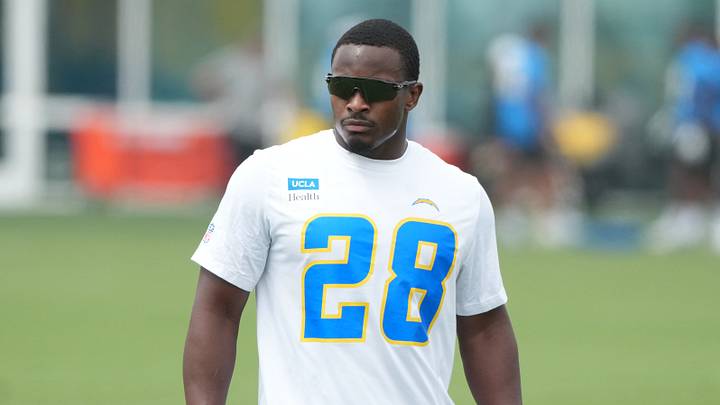
Heading into 2026, the Los Angeles Chargers have a lot to be optimistic about— especially in their run game.
While the heart of the Chargers offense under Greg Roman was meant to be their ground attack, they were never able to truly get things going between the tackles as a result of their sub-par interior protection. They routinely failed to convert consistent gains on the ground, and by extension, Roman's play action-heavy passing attack fell short as well. There simply weren't enough answers in Los Angeles playbook.
With a healthy Omarion Hampton, the addition of Keaton Mitchell, and (above all) the integration of Mike McDaniel's West Coast-style scheme, things should soon be looking up for the Chargers. But as we enter the season, one crucial question still remains.
How will the workload be distributed among the Chargers' three-headed monster in the backfield?
Both Hampton and Mitchell, with their burst and wide-zone athleticism, are clear fits within McDaniel's scheme. But Vidal, who did his best work last season breaking through the A or B gaps into the second level and bouncing off of would-be tacklers, doesn't necessarily possess the same skill-set.
Apart from simply cracking the roster and proving that he was worthy of an NFL opportunity, acclimating to McDaniel's scheme will be the most distinct challenge of Vidal's young NFL career. Although not in as direct of terms, he acknowledged as much in his press availability on Monday.
Chargers RB Kimani Vidal on adjustments to Mike McDaniel's offense: "Moreso getting off at the snap, especially with the wide zone stuff-that's probably the main important thing for the RBs."
— Alex Insdorf (@alexinsdorf99) August 17, 2026
"Some of the nuances in the receiving game for the running backs, but that's more… pic.twitter.com/4BjLJI813Y
Kimani Vidal will have a chance to carve out a role— but he still has some work to do to earn it
When the backfield took shape—with all three of Hampton, Mitchell, and Vidal presumably on the roster—speculation immediately abounded about if one of the three weapons could quickly be sidelined over the course of the season. McDaniel put that to rest last week when he stated that he intends to regularly use all three backs on a game-to-game basis.
But Vidal didn't necessarily justify that comment in the Chargers' preseason opener against the Houston Texans.
Granted, he took only five carries. But he totaled only eight yards and failed to catch his lone target of the game. It was clear from the jump that he didn't have the burst that even former UDFA and current practice squad candidate Amar Johnson had out of the backfield.
Vidal does possess a pass-catching skill set, which could be an important differentiator. He totaled 16 receptions for 136 yards and a touchdown last season. But so does Hampton— and that's likely an integral part of how McDaniel plans to utilize the second-year back. So does Mitchell to some extent.
An outside zone or "wide" zone scheme is dependent on more than athleticism and speed, though. It's dependent on timing— a running back needs to be able to read their linemen and have their footwork down to a tee to decide whether to cut inside or take the ball laterally.
Vidal has earned the opportunity to adjust to those demands with what he provided for Los Angeles in 2025. But it won't be an easy adjustment, and his performance against the Texans proved that.
 Add us as a preferred source on Google