

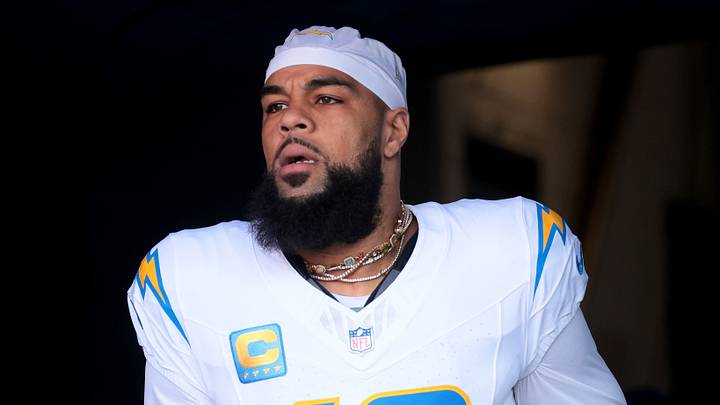
When the Los Angeles Chargers let veteran wide receiver Keenan Allen walk in free agency this offseason, the decision felt, if not entirely justified, like a worthy gamble on the structure of Mike McDaniel's offense.
The anticipation was that McDaniel's focus on YAC opportunities would lead to leaps from all three of Ladd McConkey, Quentin Johnston, and Tre' Harris. Having Allen in the fold, even as an additional veteran presence in the room, could jeopardize Justin Herbert's willingness to lean into the dynamic pass-catching abilities of those pieces.
Well, almost nothing went according to expectation for the Chargers this season. And this was easily one of those disappointments.
We've seen flashes out of McConkey and Harris through the first 11 weeks of the season, but McConkey's health issues and Harris's inconsistencies at the catch point have prevented either of them from establishing themselves as a primary receiving option in Los Angeles. Allen, meanwhile, has been highly effective this year—not just with another team but, over the past two weeks, in a West-Coast, Shanahan-style scheme in San Francisco.
Letting Allen walk was one of many gambles on Los Angeles' part this offseason on the ability of McDaniel to transform this team offensively. And as Allen continues to produce elsewhere, it merely looks like another miscalculation on the part of the front office.
Keenan Allen is still a more-than-viable receiving threat—and the Chargers could certainly use that right now
Again, the argument for letting Allen walk from the Chargers this offseason made at least some sense at the time. McConkey was entering his third NFL campaign, while Harris was going to be vying for additional snaps after forcing his way onto the field in Greg Roman's scheme due to his blocking abilities. Johnston, meanwhile, had already been guaranteed $16.5 million in 2027 as a consequence of his fifth-year option. If Los Angeles was going to come anywhere close to realizing that value, they needed to find additional targets for him somewhere.
But now that we're well over halfway through the season, it's been issues of depth that have primarily plagued the Los Angeles receiving corps. McConkey has seen a full workload in just half of the Chargers' games to this point in the campaign, and the combined injuries to Harris, KeAndre Lambert-Smith, and Brenen Thompson have left the Chargers looping practice squad receivers into the normal course of their offense on a week-to-week basis.
But even now that everyone, outside of Thompson and Lambert-Smith, is healthy, it's clear that Los Angeles is still in need of someone more reliable in the middle of the field—someone that Herbert trusts to find the holes in opposing zone defenses and hang onto the ball when they're targeted.
And Allen has steadily erased any concerns this season about his fit in a West Coast-style scheme. It's not a surprise that Allen found success in Shane Steichen's hybrid system—which both he and Herbert played under in 2020—posting 40 receptions for 351 yards and a touchdown even while the team fell apart around him. But after his move to the San Francisco 49ers at the deadline, that assumption has now been proven completely false. Across two games in San Francisco, Allen has now posted eight receptions for 99 yards, and he was even an effective piece of the offense when Mike Evans returned to the fold in Week 11.
He's still primarily a possession receiver at this point in his career, with only 19 of those yards with the 49ers coming after the catch, but a smart play caller (especially one in need of receiver depth) can find a way to make that work in complement with speedier options.
And even while the Chargers' passing game has looked more viable the past two weeks, it's hard to think that an additional, trustworthy veteran receiver wouldn't have payed dividends this season. Allen wouldn't have saved the Los Angeles offense this season—but he may very well have reduced the amount of sheer frustration that Herbert and the offense have been forced to endure.
 Add us as a preferred source on Google