

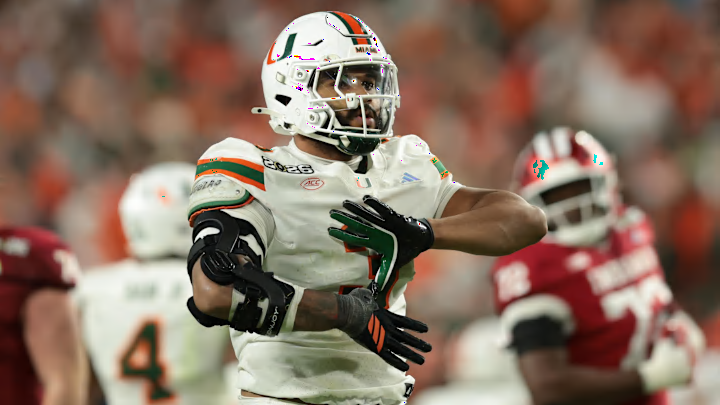
The Los Angeles Chargers' selection of Akheem Mesidor at 22nd overall in the 2026 NFL Draft was a solid bet. Mesidor has the pedigree and the college-level production to be an immediate contributor on an NFL roster, something the Chargers desperately needed after the departure of Odafe Oweh.
But the pick doesn't come without its concerns. Detractors will point to the presence of Rueben Bain Jr. on that University of Miami defense and Mesidor's season-ending foot injury in 2023 as reasons why the Chargers should've gone a different route. But the primary sticking point will always be Mesidor's age. He's already 25, and he'll be 30 by the end of his rookie contract.
On the one hand, that's a serious downside for a first-round selection. If Mesidor's athleticism begins to wane midway through his second contract, this pick may be looked back on as a mistake. But Chargers general manager Joe Hortiz provided a convincing defense of Mesidor's selection in the days following the Draft.
If Khalil Mack can still produce at this level, there's reason to have hope for Mesidor's long-term outlook.
"When you take young players with older players, you look at the long term... Like, 'Hey, second contract, third contract.' Well, I mean, we got a guy who's ... 35. Still kicking *ss." Joe Hortiz, qtd. by Kris Rhim - ESPN
Khalil Mack gives the Chargers a reason to believe in Akheem Mesidor's outlook
There, frankly, shouldn't be any questions about Mesidor's ability to produce. En route to the College Football National Championship with Miami, he posted 12.5 sacks and 55 total pressures while displaying an attractive alignment versatility along the defensive line.
The concern lies in the fact that, by the time he reaches the end of his second contract, he'll be nearly the age that Mack is now.
But edge rusher is a position where age-related decline has become less of a factor over the past few years. In his age 34 season, Mack just posted 5.5 sacks and 39 total pressures. He's lost a step and some of his athleticism over the past couple of seasons, but he's still a capable and disruptive force off the edge.
It must also be mentioned that the Mesidor selection was almost certainly made with the end of Mack's career in view. From a perspective of production, Mack probably still has a couple seasons as a capable rotational edge rusher, if not the alpha he once was. But he'll be on his second one-year contract with Los Angeles in 2026. The Chargers could not fully afford to take a pass rusher, like Tuli Tuipulotu, who might need multiple seasons to become truly productive.
Mack and Mesidor could certainly have very different career trajectories. But given Los Angeles' needs and its position in the Draft, Mesidor was a solid gamble.
 Add us as a preferred source on Google