

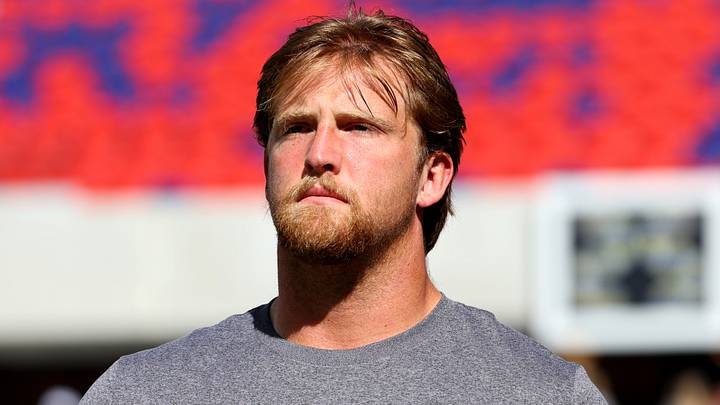
The Los Angeles Chargers took a risk by selecting Jake Slaughter in the second round of the 2026 NFL Draft.
In a vacuum, it was a fine pick. They had already added a starting-caliber center by signing Tyler Biadasz to a three-year, $30 million deal that included an easy out after 2027. They needed help on the interior, and although Slaughter had never played a snap at guard in his college career, it was worth seeing what he could do in that spot while bringing in additional competition. After all, the guard play wasn't supposed to matter as much in Mike McDaniel's scheme, right?
But the problem was that the Chargers didn't augment the selection by finding any real solutions at the guard spots, and when Biadasz went down for the season with an ACL injury, they lost the option of having Slaughter play there as well.
And although Slaughter's play has looked slightly improved in recent weeks, there's still a real question about what kind of option he his at center, let alone either of the guard spots, in the long-term. It makes an already difficult path to chart even cloudier for the Chargers' front office.
Even with further additions this offseason, Jake Slaughter needs to prove himself as a future piece of the Chargers O-line
Now, the learning curve for a rookie entering the NFL, even as one of the best college players at his respective position, is always high. And the circumstances haven't been especially conducive for Slaughter to find consistency this season with the Chargers.
He's played next to four different left guards so far this season, and Cole Strange, on his right side, has been among the least consistent protectors in the league. But the primary concern with Slaughter coming out of the Draft, even if he was going to stick long-term at the center position, was his lack of a true anchor. He's wound up on the ground more than almost every center in the league this season on a down-to-down basis, and his season-long stats bear that out.
Through the Chargers' first nine games, he's allowed 14 pressures on 354 pass-blocking snaps while consistently posting below-average production in the run game.
Now, things started looking up for Slaughter last week against the Baltimore Ravens. It was the best outing the line as a whole has had this season in the run game, and Slaughter allowed just one pressure against the Ravens interior over the course of the matchup. Perhaps he's turned a corner, and we'll start to see some truly viable production from him moving forward.
But even if that's the case, where do the Chargers go from there?
Biadasz's contract is almost fully guranteed next season—Los Angeles would need to take on a $10.75 million dead cap hit if they were to let him go. Slaughter's timeline to become the full-time starter at center, assuming Biadasz is healthy, is 2028—when the Chargers would take on just a $3 million dead cap hit by removing him from the roster.
And it doesn't seem like a truly viable option to move him to guard, either. The Chargers tried the competition schtick this offseason, bringing in a number of backup-caliber players in the hopes that one would emerge as a true starting option at left guard. It didn't work—and it's doubtful that it would've worked even if Slaughter would've been able to remain in play for those snaps.
So the Chargers need to make real additions at both guard spots this offseason. But Slaughter, even as a second-round pick, is someone they've already invested heavy draft capital in. Are they willing to take a full year off of his development in order to patch those holes immediately?
Things would be different here if Slaughter had emerged as a true starting option at center in Biadasz's absence—perhaps a trade of some sort could be in order this offseason in order to give the rookie runway moving forward. Or at least there would be some sort of confidence that Slaughter can step in immediately when it was time to move on from Biadasz.
But the fact of the matter is that he hasn't accomplished that, and the Slaughter selection hasn't gotten the Chargers any closer, at least in the short-term, to establishing the sort of interior protection they need.
 Add us as a preferred source on Google