

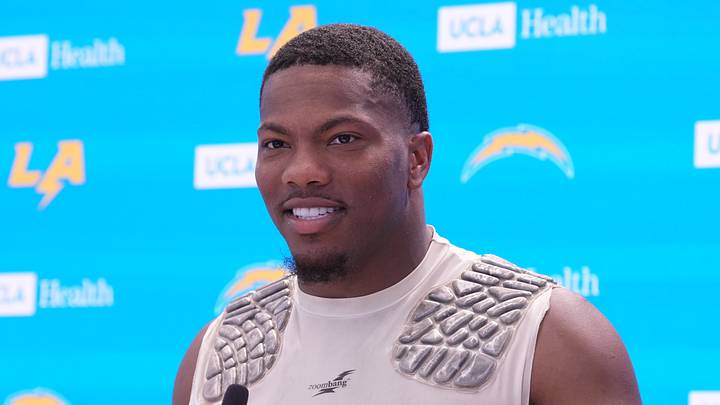
The Los Angeles Chargers got a bit of a bombshell last night when it was announced that the Denver Broncos had backed out of the Daiyan Henley trade, where the two parties had agreed to send the linebacker to Denver at the deadline in exchange for a 2027 fourth-round and a 2028 fifth-round selection.
The immediate fallout was obvious. The Chargers would exit the trade deadline with an 0-8 record and without any additional draft capital to show for it. Henley would return to Los Angeles and play there until his contract ran out at the end of the season.
But the circumstances behind the decision weren't immediately clear. Did Henley fail his physical? Or was there something else that gave the Broncos cold feet about the trade and gave them an excuse to pull out?
According to Ian Rapoport, the situation goes further than that. Apparently, the Broncos took issue to a knee issue that came up during Henley's physical in addition to the shoulder issue that's kept him on the injury report in recent weeks. They then asked the Chargers to re-negotiate the trade, and talks ultimately fell through, sending Henley back to Los Angeles.
From @GMFB: A more detailed look at how and why the Daiyan Henley trade was called off, with the #Chargers ultimately ending up with a player they didn’t really want to trade, anyway. pic.twitter.com/xUCssene1K
— Ian Rapoport (@RapSheet) November 12, 2026
Here's where things get weird. According to Rapoport, the Chargers never wanted to trade Henley in the first place—the package from the Broncos was simply too good to pass up, and they always planned to attempt to re-sign him in the offseason.
But why, if the message to the team in the public was that the Chargers aren't "giving up" on this season, was trading Henley an option in the first place—unless there was never a real plan to re-sign him this offseason? Things simply aren't adding up.
The Chargers' Daiyan Henley saga only gets more confusing with each mounting update
Alright—let's lay out what makes sense here.
The Athletic's Noah Furtado reported, in the wake of the trade, that the Chargers had made attempts to get Henley to sign an extension. But there was no reporting that indicated any true progress on a deal over the course of the season.
Henley will likely want an extension close to the $15 million annual value Devin Lloyd commanded on his recent contract. He's a leader on the Chargers defense, and the green-dot player, and he certainly deserves that figure in a vacuum. But Los Angeles also has to deal with the Tuli Tuipulotu extension as well as pay raises for Ladd McConkey and Joe Alt in 2028. Handing over $15 million to an off-ball linebacker, especially one whose performance has dropped off over the past two seasons— when there are contributors like Marlowe Wax and Del'Shawn Phillips ready to step up in that room would be seen by many as less-than-optimal team building.
So, in this sort of scenario, the Chargers got top value for an expiring contract—even if it went to a division rival, they were able to recoup some additional draft capital and avoid losing Henley for nothing this offseason.
But according to Rapoport, that's not what happened. Instead, the Chargers always intended to re-sign Henley.
Perhaps there's a world where Henley settles for something closer to $12 or $13 million annually, giving Los Angeles a bit of wiggle room to fit him onto the books even with all of the changes it's going to need to make this offseason on the offensive side of the ball. But if there were a chance of that, and the Chargers were truly committed to hanging onto the players they view as cornerstones of the organization through the trade deadline, why move Henley in the first place? Why not do the same thing with Khalil Mack? Or with Tuipulotu—players they also didn't want to trade?
This feels, intuitively, like a spin pipelined straight from the front office to cover up an embarrassing and awkward trade deadline situation.
But either way, this whole thing is simply another hallmark of a rudderless and relatively directionless Chargers front office as the team sputters, winless, past this year's trade deadline. And the case for this regime staying in place isn't getting any stronger in the meantime.
 Add us as a preferred source on Google