

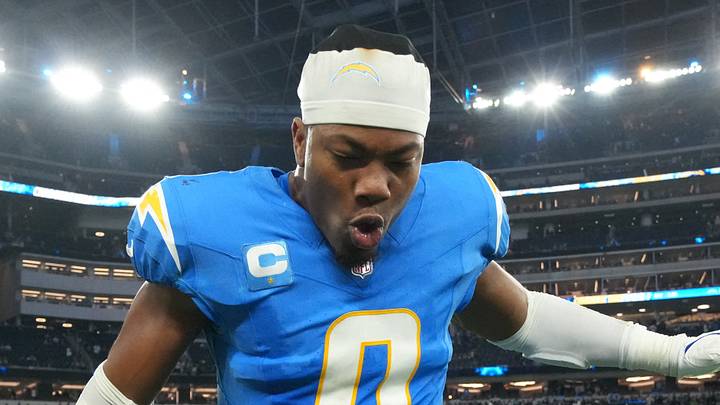
Of course, the Los Angeles Chargers didn't gain anything at the trade deadline. And it's unlikely that the surprising return of Daiyan Henley to the roster—after the Denver Broncos backed out of the trade that was supposed to send him to the division rival in exchange for a pair of mid-round selections—makes any real difference to the ultimate on-field product for the remainder of the season.
But it very well might make a difference in how the Chargers' re-construction of their roster goes this offseason.
According to the front office, this was a case where they never wanted to trade Henley in the first place—the package the Broncos offered was simply too good to pass up in exchange for an expiring contract, and Los Angeles was going to attempt to re-sign him in free agency anyways.
That feels, in part, like a clean-up attempt from the front office after some trade deadline confusion sent one of the leaders of the locker room on a plane back to Los Angeles. But Henley is here for now, at the very least, and that changes the complexion of the linebacker room at least for the remainder of the season.
But what does it look like moving forward? Is Henley a part of the picture, and where do the Chargers go if he's not?
Chargers need to chart out a path forward in the LB room—whether that involves Daiyan Henley or not
Even if the Henley trade had gone through (and the Chargers had actually 'wanted' to trade Henley in the first place), they had more than enough depth to make things work through the end of the season. Both Del'Shawn Phillips and Marlowe Wax, who were largely special-teams pieces until this season, have emerged as solid contributors at the position.
Wax was one of the Chargers' best performers in preseason, consistently showcasing his intensity against the run and, just last week, making an excellent play in coverage to produce an interception for Henley on a tipped pass. Phillips, meanwhile, has been effective against the run as well—but the blitz is where he's really shined. He's posted five total pressures on the season on just 18 pass-rush snaps, and although he hasn't made contact with the quarterback often, you can see his impact pretty easily on tape when Chris O'Leary chooses to use him in that capacity.
Los Angeles also has Troy Dye, who was relatively effective across 473 snaps at the position last season, and Denzel Perryman seems to be set to make his season debut in the near future. Fomrer third-round pick Junior Colson is also on the practice squad after being left off the 53-man roster at the start of the season. If Henley were out of the picture this week, it's likely that Wax and Phillips would take over the two starting spots, while some combination of Dye, Perryman, and Colson would take on the rotational/special teams snaps.
But Henley is still an impending free agent. So, for that matter, are Dye and Perryman. Phillips is under contract through next year, although his cap hit will almost double assuming he's still on the roster.
It's still possible, at least theoretically, that Henley returns to the team in free agency. He's a consummate professional, and he likely understands the business aspects of what the Chargers had to do at the trade deadline. But he's likely going to want something close to the $15 million annually that Devin Lloyd got on his recent deal, and if he and the Chargers already weren't close on negotiations, this whole saga certainly isn't going to expedite things.
Los Angeles also has to account for the looming extension for Tuli Tuipulotu as well as pay raises for Ladd McConkey and Joe Alt in 2028. It's reasonable, then, if they're hesitant to allocate that sort of capital to an off-ball linebacker who's seen declining consistency and production over the past two seasons. That would explain their reason for trading him, after all, even if the front office (naturally) doesn't want to publicly admit it.
So let's assume Los Angeles enters the offseason with Wax and Phillips as their two off-ball linebackers under contract. Their salaries combine for a total of just under $6 million for next season, but it's unlikely that O'Leary would be comfortable with them as the only true options in the room. It also feels likely that the team will move on from Perryman this offseason considering his availability issues—he's played in just 21 of a possible 42 games since his arrival in Los Angeles in 2024.
That likely means a new contract for Dye, who has proven in the past that he's capable of taking on snaps as the third linebacker, and perhaps a minor signing or a draft pick to present some competition for Colson for the fourth roster spot in the room.
There's more variance in that sort of room than the Chargers might necessarily prefer, especially without the run-defending skill sets of either Perryman or Henley. But with the money they need to spend on the offense this offseason, it seems like a reasonable sacrifice to make in terms of team-building.
If Henley does return, that likely means a departure for Dye—who can almost certainly stick on as a special-teams piece elsewhere in the league as he enters his age-31 season.
Either way, Los Angeles has flexibility here. It's why it made the trade in the first place, and Henley's return changes nothing outside of the amount of draft capital they'll have at their disposal this offseason.
 Add us as a preferred source on Google