

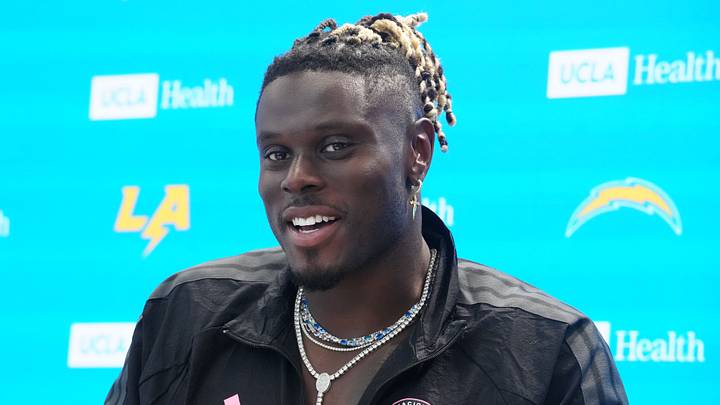
When the Los Angeles Chargers signed David Njoku this season, the reasoning behind the deal was clear for both parties.
Njoku, who just had easily the least productive full season of his career with the Cleveland Browns, needed a chance to turn things around on a one-year pact before attempting to seal one more long-term deal before the end of his career. His one-year, $3 million deal—with incentives ranging up to $8 million—was a worthy gamble on his part.
For Los Angeles, it was a swing to bring in a perfect bridge between Charlie Kolar and Oronde Gadsden II's skill sets. Njoku can operate both as an in-line blocker and a relatively dynamic pass catcher, and having him out there in multiple tight-end sets, at least theoretically, granted the Chargers extra flexibility on offense.
But Njoku's start to the season didn't go as planned. He was placed on the IR with a knee injury after a solid first two weeks, and he's now missed three games and will miss at least another. With his return presumably looming, though, Los Angeles has a chance to maximize the value of his deal—and do Njoku a favor in the process.
As the attention of this organization turns toward building for next season, Njoku may very well present an opportunity for Los Angeles to amass some additional draft capital.
Trading David Njoku should be on the table for the Chargers after 0-5 start
Njoku certainly isn't the most obvious trade candidate on this team. Apart from the fact that he's missed most of the season to this point, he doesn't play at a premium position, meaning that there will likely be less teams clamoring to hand over draft capital for him before the trade deadline arrives on Nov. 10.
Khalil Mack is likely the clearest trade candidate on this roster. He signed another one-year pact with hopes of competing for a Super Bowl, and as he rounds out what's likely the final season of his career, the Chargers can likely gain a Day 2 selection by shipping him off to a potential contender like the Chicago Bears or San Francisco 49ers. Donte Jackson is also a real trade candidate, as is Denzel Perryman and (perhaps) Quentin Johnston.
But as the tight end revolution continues, Njoku's versatile skill set doesn't present more than just a potential boon to the Chargers offense.
To this point in the 2026 campaign, there are 10 teams that have utilized 13 personnel (with three tight ends on the field at once) at least 10% of the time—compared to a total of three teams in that category last season. Teams across the NFL are learning to leverage these heavy sets to diversify both their run and pass games, and having a bevy of viable tight ends is a necessity for many of these squads.
The Carolina Panthers, for example, have run 13 personnel at a relatively high rate of 7.46% this season, but their depth at the position is less than inspiring—Darren Waller is currently functioning as one of their primary tight ends. The New England Patriots also have depth needs at the position, as do the Denver Broncos (if the Chargers were willing to work an in-division trade).
For Njoku, moreover, the Los Angeles offense simply hasn't shown enough to imagine he's bought in on a rebound season with the team. Moving him for, say, a fourth or fifth-round pick before the trade deadline could be a solid option for the Chargers.
They have the depth to survive without him, with Kolar and Scott Matlock recently returning from injury. That makes him a clear trade candidate to monitor between now and Nov. 10.
 Add us as a preferred source on Google