

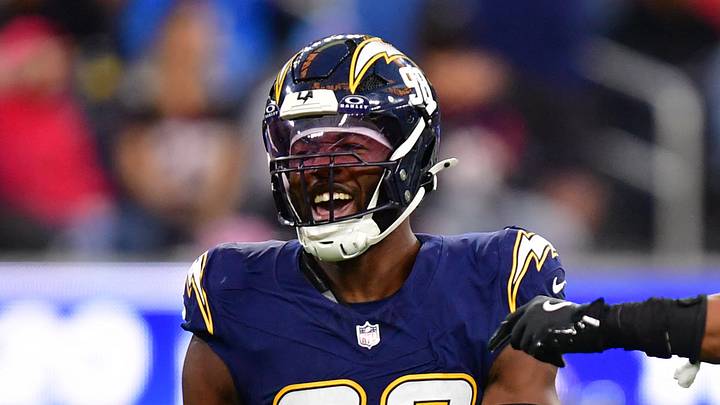
The Los Angeles Chargers suffered a major blow this offseason when they lost Odafe Oweh to the Washington Commanders.
In fairness, they were never realistically going to match the four-year, $96 million deal he signed with Washington, especially with extension talks for Tuli Tuipulotu still dangerously lingering. Their plan was likely always to fill that need using top draft capital, and they accomplished that by selecting Akheem Mesidor at 22nd overall in the 2026 NFL Draft. While it will be a challenge for Mesidor to match Oweh's production this season, his $3.7 million cap hit in 2026 leaves some major room for error on Los Angeles' part.
There's also no guarantee that Oweh, when he's anything more than a rotational pass rusher, will be able to make the same impact on a game. He had a small sample size of dominance with the Chargers, and Los Angeles wasn't willing to fork over a hefty contract in exchange for that.
But Washington was, and it appears as though Oweh began to justify that decision through the Commanders' offseason program. Commanders beat writer Zach Selby identified Oweh as one of the most intriguing players in Washington's mini-camp back in late June. Here's what he had to say about the former Charger:
"When I look at this Daronte Jones defense, what drives it? It's pressure. We gotta get after the quarterback. [Oweh] had 11 sacks last season in an abridged time, post trade from Baltimore, and he looks like a superhero ... That helps up the secondary. So, he's making a lot of money. He's gonna have a huge role in this thing, and again, if he can affect the quarterback, this defense will be rolling."
Chargers fans can echo the sentiments here. Oweh is an impressive physical specimen, and his ability to disrupt the quarterback consistently is highly valuable for any modern NFL defense. But there's a question implicit in Selby's glowing recommendation, and it's one Chargers fans have already considered at length.
Odafe Oweh is a disruptive pass rusher, but what happens when you count on him for more consistent production?
Last season, after Khalil Mack went down in Week 2 with a rather gruesome arm injury, Los Angeles quickly realized it couldn't depend solely on Bud Dupree and Kyle Kennard to make up for their lack of front-line edge rusher talent. Joe Hortiz picked up the phone and swung a deal with the Baltimore Ravens to bring Oweh to the town.
The deal worked out for both parties. Oweh opened up the Chargers' defensive game-plan, especially once Mack returned, posting 7.5 sacks across just 12 games in Los Angeles. Alohi Gilman, who Los Angeles sent away in the trade, played a major role in the Ravens defense, allowing Kyle Hamilton to slide into a Derwin James-esque role for the remainder of the season. It was, in short, a win-win trade for both parties.
But now the Commanders must deal with the implications of Oweh's massive campaign. Based on his 2025 production alone, he certainly earned his hefty deal. And Chargers fans can easily connect with Selby's descriptions of Oweh. At times, he did look like a 'superhero' with Los Angeles, especially when he was paired alongside Mack and Tuipulotu.
But in Washington, Oweh will be asked to take on a role as an alpha pass rusher. His counterpart, K'Lavon Chaisson, had a strong, 7.5-sack campaign in 2025 with the New England Patriots. But their depth beyond that pairing— which includes veteran Dorance Armstrong and fifth-round pick Joshua Josephs— doesn't inspire much more confidence than the Chargers' did last season prior to the Oweh trade.
Selby is right in claiming that Oweh will play a major role in the Washington defense no matter what in 2026. And Chargers fans know that exact feeling of seeing what Oweh can do athletically on the field.
But Oweh's role with the Commanders comes with a lot more questions than his tenure in Los Angeles did, and Chargers fans are also well-aware of the risk that comes with signing him to that hefty of a contract. When the focus is on Oweh, it's not certain that he'll be able to make the same impact he did in Los Angeles.
 Add us as a preferred source on Google