

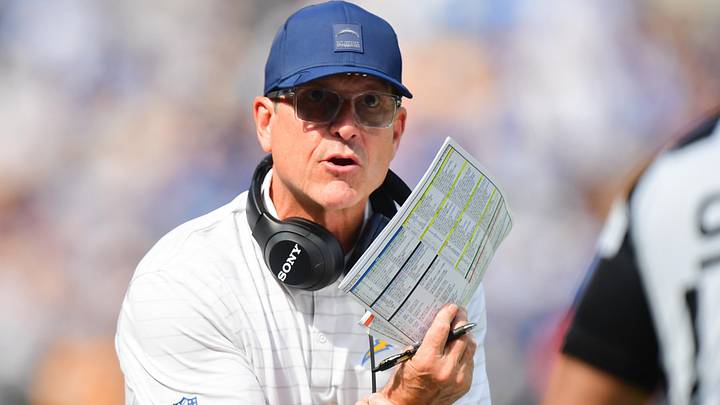
The Los Angeles Chargers, despite their back-to-back 11-win seasons, have yet to find true playoff success under this new regime of Jim Harbaugh and Joe Hortiz.
They've taken strides, of course, and with two new coordinators in the fold, it seems as though they're poised to take that leap in 2026. The roster is as complete as you could ask for, primarily as a result of Hortiz's conservative approach. Although he has his critics, especially those that called for him to be more aggressive in the early stages of free agency, the Chargers now have balanced books and a strong, competitive roster heading into the new season.
That doesn't mean their path to an AFC West title will be easy, however. The Denver Broncos are returning many of the same pieces from their impressive 2025 roster, and their defense projects to be just as formidable as it was in their run to the AFC Championship Game. The Kansas City Chiefs, meanwhile, are looking to make an offensive turnaround with the reigning Super Bowl MVP, Kenneth Walker III, under their belts.
But even a quick look at the three teams' salary situations reveals a clear picture. The Chargers are best suited for long-term dominance in the division as a whole, and the Chiefs' recent commitment to Patrick Mahomes makes that statement even more true.
The Chiefs' dynasty is coming to an end, and it will be a result of their cap allocation
On Wednesday, it was announced that Kansas City would be reworking Mahomes' contract, adding an additional two years and bringing the grand total of the deal above $500 million. In the short-term, this grants the Chiefs some flexibility to re-work their roster. The chickens will come home to roost eventually, however.
Per Spotrac, Mahomes' cap hit will be $90 million in 2027— or a whopping 29.97% of the projected cap. In 2033, when Mahomes is 38 years old, his cap hit will be $70 million.
Beyond that, though, Kansas City also has some short-term deals they'll need to work around. Bleacher Report recently ranked Chris Jones' five-year, $158.8 million deal as the sixth-worst in the NFL. As Jones' production continues to wane, he'll be owed just over $44 million this season and close to $83 million between 2027 and 2028.
The Chiefs were already forced to move off of star cornerback Trent McDuffie. Although they were able to replenish their roster in the short-term, these commitments will certainly make it difficult to keep adding talent to the roster outside of the Draft.
The Broncos, for their part, have the fifth-oldest roster in the NFL. It will be a tall task to maintain their defensive dominance while cycling out their veteran cornerstones.
The Chargers, meanwhile, are a team on the rise. Justin Herbert is under contract through 2029 at a relatively modest value for a quarterback of his caliber. They do have extensions to sort out for Tuli Tuipulotu (this offseason) and Joe Alt (next offseason, or they can his fifth-year option). But they've constructed their roster in a way that this should be easily attainable. They still have a projected $65 million in cap space in 2027 even after the hefty Derwin James extension.
The Chiefs, meanwhile, are currently projected to be $18 million over the cap heading into next offseason.
This outlook leaves the Chargers with a clear path to long-term sustainability and, hopefully, an AFC West title.
 Add us as a preferred source on Google