

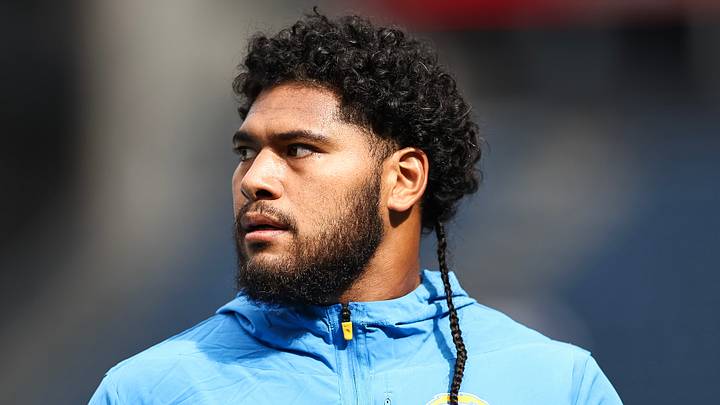
Things haven't all been rosy for Chris O'Leary in his first season as the Los Angeles Chargers' defensive play caller. The outing last week against the New York Jets, and the unit's inability to stop the run, was more than enough evidence of that fact.
But on the whole, O'Leary has filled in impressively for Jesse Minter, who vacated the role this past offseason in order to accept a head coaching job with the Baltimore Ravens. He's fought through seemingly endless injuries, developing options in the secondary, the linebacker room, and along the interior of the defensive line that have served Los Angeles well. Barring a complete organization reset, it seems like he's done more than enough to earn the right to keep calling plays beyond this season.
To this point in the campaign, the Chargers are 18th in total opponent passing and 16th in total rushing—not necessarily elite numbers, but tenable enough considering the season-long sample size. Where the Los Angeles defense has truly fallen flat, though, is in the pass rush—they're currently 26th in the NFL in pressure rate and tied for 32nd in total sacks with the Miami Dolphins.
There are a number of reasons for this drop-off in performance for Los Angeles—but depending on the future of Khalil Mack, the Chargers need to seriously consider a move to augment the pass rush this offseason.
The only problem is that there's not necessarily an easy way to do that impactfully.
The Chargers need a viable pass rush if they're going to make Chris O'Leary's defense elite
Now, the Chargers' lack of pass-rush dominance doesn't come as a complete surprise. It simply wasn't a key point of Minter's scheme, and it didn't project to be under O'Leary. But even in 2025, the Chargers finished 13th in pressure rate and 11th in total sacks while keeping their blitz-frequency near the lowest in the league.
So what accounts for the drop-off in both categories?
Tuli Tuipulotu has still been highly effective as a pressure-producer, amassing 34 pressures through 10 games—although that's well under the mark of 48 he set in that same span last year. But his ability to convert those pressures into sacks has fallen off significantly. After a 13-sack campaign in 2025, Tuipulotu has just two over halfway through this season. Mack has continued to see a steady decline in pass-rush production as well, and when you combine that with the variability that a rookie in Akheem Mesidor brings to the table, that's an immediate recipe for some up-and-down moments in the pass rush compared to last season.
In theory, though, the Chargers still have a pretty formidable three-man combination in Tuipulotu, Mack, and Mesidor. Both Tuipulotu and Mesidor are capable of lining up on the interior when asked, and Los Angeles has been vastly more effective this season when they have all three of their main pass rushers on the field.
But running it back simply with this same combination next year, minus Bud Dupree, simply won't be good enough.
Will the Chargers extend Tuipulotu, and at what number? That depends on what version they expect to get of him long-term. Is he the alpha pass rusher we saw in 2025, or is more of the middling pressure producer we've seen this season? Either way, it doesn't seem like moving off of Tuipulotu, and entrusting the future of the room to Mesidor, is a real option for Los Angeles right now.
And how much production can the Chargers expect out of Mack moving forward?
Having all three of Tuipulotu, Mack, and Mesidor on the roster next season is a more than acceptable outcome, of course. If Mack wants to keep playing, though, it remains unclear if the $18 million annual value the Chargers have given him on each of his last two deals remains viable any longer. Perhaps part of that salary could be spent on another veteran, pure pass rush option to give the Chargers some flexibility in how they use Mack. He's best utilized more heavily as a run defender at this point in his career, after all.
Or, if the Chargers' fortunes over the remainder of the season don't bring them the first overall pick, perhaps an edge rusher like Colin Simmons or Dylan Stewart may be on the table. More realistically, though, a Day 2 pick to augment the pass rush and replace Dupree's spot in the rotation seems like a solid option.
The point is this, though—the Chargers are in a tough place here. If the offense was any good this season, there would be plenty of discussion about what's gone wrong on the defensive side of the ball, specifically with the pass rush. Running it back with an aging Mack and hoping for a rebound from Tuipulotu won't be enough if the Chargers are hoping to rebound to Super Bowl contention next season.
But Los Angeles' options outside of extending Tuipulotu are relatively slim. Bringing in a fourth edge rusher via free agency isn't going to make the difference, and entrusting the pass rush to Tuipulotu, Mesidor, and a mid-round pick likely won't either.
No matter what, they'll need to thread a needle this offseason, given the needs they have elsewhere on the roster, when it comes to making any tangible improvements to the room.
 Add us as a preferred source on Google