

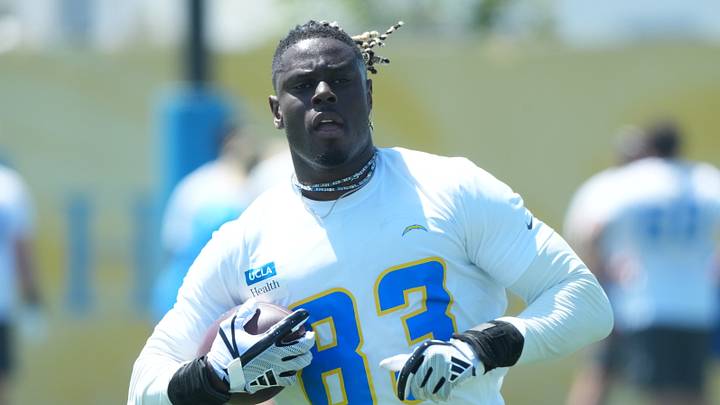
When the Los Angeles Chargers added David Njoku in the middle of this past offseason to fill out their tight end room, it seemed like a serendipitous fit.
Even with the addition of Charlie Kolar at the start of free agency, the Chargers needed an additional piece that could bridge the gap between him and Oronde Gadsden II. Njoku, as both a dynamic pass catcher and a capable blocker, represented that sort of player, and he also was an obvious upgrade over the likes of Tucker Fisk and Will Dissly.
On Njoku's part, the veteran tight end was looking for a chance to rebound from a down year production-wise with the Cleveland Browns—where he was asked to take on more of an in-line blocking role with the emergence of Harold Fannin Jr. Even in a Chargers offense that would be tight for targets, he theoretically had a chance to revive his value and earn one more long-term deal before the conclusion of his career.
But then the Chargers offense sputtered to start the season. Then it sputtered again, and Njoku went to the injured reserve with a leg injury. He has not played since Week 2, and he's amassed just six catches for 67 yards on the season.
Now, with Njoku's practice window "likely" being opened this week, according to Jim Harbaugh, there's a difficult truth the veteran must face. This offense simply isn't consistent enough to provide him with the revival he was seeking, and he'll likely be in a poor position entering the market again this offseason.
David Njoku hasn't gotten what he wanted out of his time with the Chargers
Now, Njoku was never going to be the primary playmaker for this offense. But it wasn't unreasonable to think there was more pass-catching upside to be unlocked there than Cleveland utilized last season. We're only three years removed from Njoku's Pro-Bowl campaign, in which he posted 81 receptions for 882 yards and six touchdowns.
The Chargers, moreover, were expected to lean more heavily into 12 and 13-personnel looks under MIke McDaniel now that their tight end room was replenished. To this point in the season, they rank 28th in 12 personnel usage and 23rd in 13 personnel, per Sumer Sports.
Now, this a sort of 'chicken or the egg' situation, and it's likely that McDaniel's intended usage of these looks has been heavily impacted by the injuries to Njoku and Kolar. It's unclear whether the return of both pieces to the roster will entice him to reverse course on the implementation of those sorts of groupings.
But what's more concerning is that, in the six weeks Njoku has missed, Los Angeles hasn't shown any improvement on the offensive side of the ball, neither in terms of their cohesion nor their ability to move the ball downfield with any consistency. They currently rank 32nd in EPA/play, 29th in total passing yards, and 32nd in total passing touchdowns. Their leading receiver, as of now, is Ladd McConkey—who has 286 yards through six games despite being limited by various injuries even when available. That's come on just 17 receptions.
Njoku's addition may very well be a boost to the offense. At the very least, it means Los Angeles can move Hayden Rucci out of the fold at tight end.
But with the way this unit has looked to this point in the season, it's hard to think that Njoku is going to come anywhere close to putting together a productive campaign, likely leaving him to sign another one-year deal elsewhere when he hits free agency again this offseason.
 Add us as a preferred source on Google