

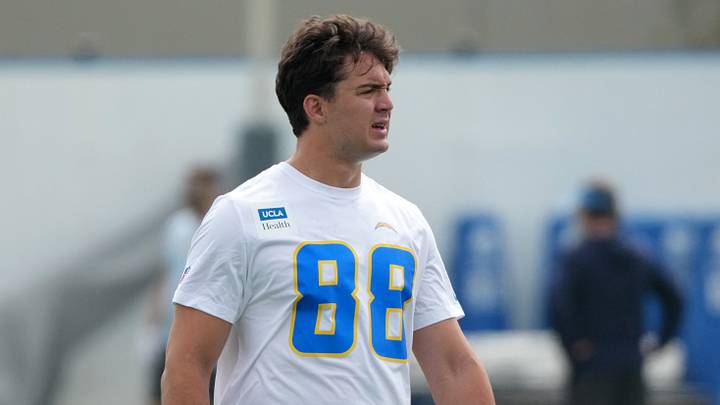
At this point in the season, the Los Angeles Chargers' only hope of a major turnaround is if we see MIke McDaniel's offense flip a switch between now and their Week 7 bye.
In theory, there could be some miraculous turning of the tides in wait for the Chargers. McDaniel is a schematically innovative coordinator, and with a quarterback of Justin Herbert's talent at the helm, it should simply be a matter of growing pains and slight adjustments. A top offense going through a rough period, though, more often than not simply looks like an average offense. The Chargers have had the third-worst offense in the league by EPA/play over the first three weeks, leading only the Pittsburgh Steelers and Tampa Bay Buccaneers in that category.
I don't need to tell you that neither of those teams possess playoff offenses.
So what does a turnaround even look like at this stage for Los Angeles?
The obvious answer is that it's accomplished through the air. The Chargers have struggled to funnel the ball to anyone outside of Ladd McConkey, and their inability to consistently get intermediate gains with Herbert's arm has severely limited their overall potency.
But in reality, the ground game is where this truly needs to start, and with Charlie Kolar out, Los Angeles simply doesn't have the blocking talent it needs to maximize McDaniel's outside-zone rushing attack. In short, Kolar needs to return before this offense can be truly whole again.
Charlie Kolar is still a key piece of the Chargers' offense (even if the blame falls elsewhere for its shortcomings)
There's a reason the Chargers were willing to extend Kolar an above-market deal this offseason, even when they were hesitant to make splash moves through the rest of free agency. Although Oronde Gadsden II showed some excellent flashes as a pass catcher last season, the blocking talent and consistency simply aren't there. Los Angeles needed a tight end they could keep on the field on a down-to-down basis—someone who could both help seal the edge for the explosive Omarion Hampton and provide an extra set of hands in the passing game.
Although the run game struggled through the first two games of the season, Kolar held up his end of the bargain. He put up run blocking grades of 68.8 and 75.2 (per Pro Football Focus's system), respectively, in Weeks 1 and 2. Hampton averaged just 3.9 yards/attempt through that pair of matchups, but that was largely because of the failings of the interior to create space for him when they were called upon.
The run game, though, bottomed out in Week 3. Hampton put up just 56 yards on 15 carries—a massively underwhelming effort when the Chargers had a chance to bury the Bills with a strong lead in the first half. Hayden Rucci, who Los Angeles signed off the Jacksonville Jaguars' practice squad to temporarily replace Kolar as a blocking tight end, put up a run blocking grade of 68.0. He largely held up his end of the bargain as well.
So why does the run game ultimately hinge upon Kolar?
Kolar is the type of piece that is an additional luxury for an offense that is truly clicking. He can't turn the offense around by himself, but he has the force, violence, and athleticism to help turn an average run game into an elite one. No matter who the Chargers put at tight end in the meantime, then, their ceiling is limited on the ground without a dependable blocking tight end to leverage within McDaniel's scheme. Rucci looked solid in his first game, but he simply doesn't possess the versatility that Kolar does.
This doesn't mean we can't see improvement, though. Both Cole Strange and Trevor Penning were abysmal in Week 3, and both are going to need to take major strides over the coming weeks (assuming Kayode Awosika can't return) if this offense is going to gain any momentum whatsoever.
Kolar, importantly, did not go to the injured reserve with the arm injury he suffered in Week 2. If the Chargers can start to gain some momentum on the ground in the meantime, Kolar's return within the next couple of weeks could be the thing that finally helps put this offense together, giving McDaniel his full complement of weapons and a significantly more well-adjusted roster.
If the ground game is clicking, McDaniel and Herbert can unlock more options through the air—not to mention accomplish their presumptive goal of simplifying the offense as a whole.
Perhaps there is no way to put this offense together this season. But Kolar's return, no matter what, should be a benchmark for Los Angeles.
 Add us as a preferred source on Google