

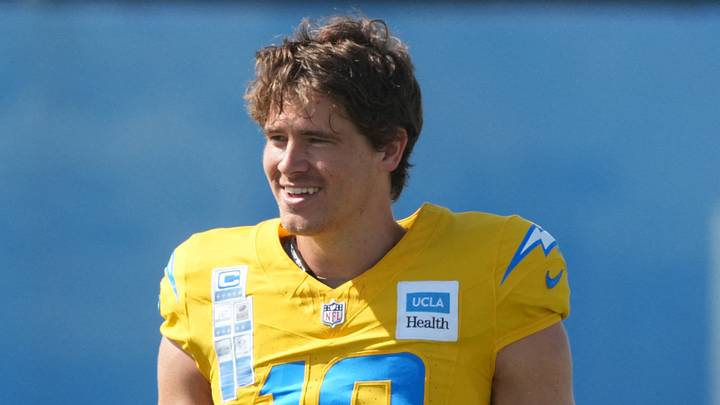
Let's start with one central statement here. The Los Angeles Chargers aren't moving on from Justin Herbert, no matter how poorly the rest of this season goes.
Sure, you could likely grab a haul of draft picks for him in the offseason—and if the belief is that this team genuinely can't compete while paying Herbert on an escalating scale over the next three seasons, then perhaps that's the best move. But how do you replace a quarterback of Herbert's talent with draft selections? Quarterbacks with that sort of physical ability and clear tendency to put a sub-par offense on their back don't just fall into teams' laps, even with a top pick.
He hasn't adjusted well to Mike McDaniel's scheme, and his turnover-worthy plays and pure on-tape mistakes are at an all-time high. But almost nobody on the offense has played up to their abilities this season. To purely blame Herbert for the way things have gone is a mistake.
In that light, all of the speculation around dealing Herbert can essentially be ignored. But there's one aspect to that narrative that carries some water. Los Angeles clearly isn't maximizing Herbert, and he looks more defeated and downtrodden than he has at any point in his career.
The Chargers' aim over the remainder of this season, then, needs to be giving Herbert his life back. Ending the trade speculation would merely be a side effect of accomplishing that goal.
Justin Herbert needs to look like himself again—and the Chargers owe him that over the remainder of this season
I'm not going to say that Herbert has been perfect this season. He's clearly been forcing throws to try to will McDaniel's anticipatory-passing scheme into viability, and he's made some poor decisions as a result. Across six games, he's completed 59.4% of his passing attempts for 1,141 yards, five touchdowns, and a league-leading eight interceptions.
But the Chargers' mission coming out of the bye shouldn't be to fix Herbert's understanding of McDaniel's scheme. It should be to tailor McDaniel's scheme to the strengths of its most important player—the quarterback.
It wasn't necessarily unreasonable to expect Herbert to acclimate to an anticipatory-throwing based scheme in one offseason, and changing his shotgun stance wasn't some massive draw on his game. But the Chargers simply didn't do enough along the offensive line, nor did they have the receiving talent, to truly give Herbert a chance to make that adjustment. McDaniel was successful in Miami because he was able to give Tua Tagovailoa a series of easy buttons to press on a game-to-game basis, limiting his room for game-changing mistakes and limiting the burden that was placed upon him in the passing game.
Herbert doesn't need that same level of accommodation. But how many 'easy' completions have we seen for Herbert his year? How often has anything truly created on offense not come directly from him and his athletic abilities? It's simply a different version of the problems we saw under Greg Roman last year—without Keenan Allen and Roman's unimaginative passing scheme to give the Chargers easy completions in the flat.
It's not reasonable to expect McDaniel to abandon his entire scheme after the bye. But relying on these anticipatory routes with Herbert and the Chargers' receiving corps clearly isn't going to pay dividends. There need to be throws and plays drawn up for the express purpose of helping Los Angeles gain even minor momentum on the offensive side of the ball—even if it doesn't lead to wins. Herbert absolutely can make those sorts of throws, just not when it's also dependent on seamless communication in an offense that clearly doesn't have it. There doesn't need to be less asked of Herbert in total, but there does need to be less asked of him when it comes to playing outside of his game.
This season is already a loss for the Chargers. The trade speculation is simply an indication of that.
The only way it's a complete and utter disaster, though, is if Herbert's confidence is shot by the end of the season. If we see him playing like himself again—which almost certainly can happen with the right adjustments—the trade speculation will die out naturally.
That should be Los Angeles' primary aim before the end of this disappointing campaign.
 Add us as a preferred source on Google