

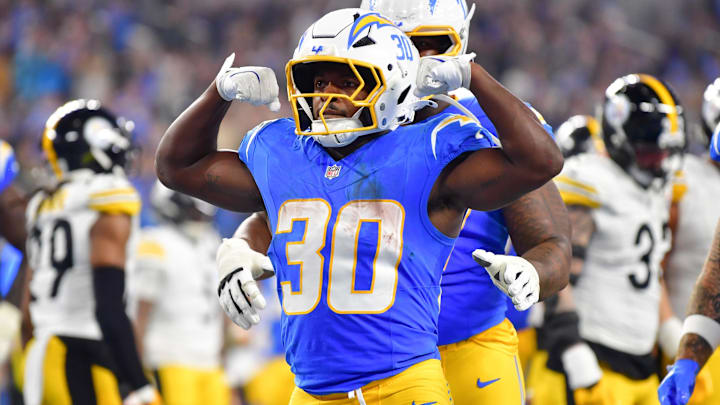
Chargers running back Kimani Vidal ended up leading the Chargers in rushing last year. He had 643 yards on the season and three 100+ yard rushing games. As crazy as it may sound, a Chargers running back hadn’t had more than two 100+ yard rushing games since Melvin Gordon in 2018.
None of it was supposed to happen. Vidal remembers being waived by the Chargers last August vividly. “When it happened, I was on the phone with my dad,” Vidal recounted in an exclusive interview with Bolt Beat. “I had went into the facility earlier that day. And I was like, ‘If they was going to do it, I would’ve hoped they had done it already’. Literally after I said that line, I got the call. And I was like, ‘aw man, they got me’.”
Vidal was re-signed to the team's practice squad. If you simulated the season 100 times, that’s probably where he would’ve stayed. But the injury bug struck the Chargers early in the year. Najee Harris tore his Achilles in a Week 3 win over Denver. First-round pick Omarion Hampton sustained multiple ankle injuries that limited him to just nine regular-season games.
His first start of the season came against the Miami Dolphins in Week 6.
Being cut by the Chargers motivated Kimani Vidal
”I’d be lying if I didn’t say i wasn’t extra motivated,” Vidal said. “Especially like the Miami one, I was extra motivated for sure. I have a lot of family that lives in Florida. Anytime we play on the east coast, I’m going to have family there. So there was definitely extra motivation for that one.”
It was Vidal’s breakout performance. He had 18 carries for 124 yards and added in a receiving touchdown.
”But there’s motivation for every week,” Vidal added. “I mean I got cut. That like never left my mind. It still doesn’t leave my mind. Because I really didn’t see it happening.”
HC Jim Harbaugh mentioned him in the teams’ plans for 2026 in a backfield that now includes Vidal, Hampton, and new free agent addition Keaton Mitchell. Harbaugh referred to the group as a “thunder and lightning type of backfield”. That’s a spot Vidal had to earn from the coaching staff throughout his two NFL seasons.
Full transcript of Kimani Vidal interview:
Alex Insdorf: “Kimani, I’ll let you start: how was the season for you?”
Kimani Vidal: “It was a great season. You know, obviously it didn’t end the way we wanted it to. But i felt like I made some good plays out there and had some good games. Just looking to build upon that next season.”
Alex Insdorf: “What did you learn this season about the NFL? You obviously get drafted in 2024 going through all that you went through from getting cut and then having the role you did on the team having to take over in some games as RB1. Staying ready when your number was called. What did you learn through all of that just about how the NFL works?”
Kimani Vidal: “First off, I would start by saying I got to see the business side of things. I didn’t expect to get cut, it happened. It was just a long process from getting to cut to those first three weeks to go through the end of the season. I don’t know, it just felt like a very long time from when I got cut to ending our season with the Patriots. But I mean I learned a lot. I learned a lot about myself. I learned a lot about overcoming challenges and things like that.”
Alex Insdorf: “One of the ways I’d say you got better specifically was pass protection. It was one of the things you hung your hat on the most this year. What kind of went into that in terms of improving from 2024 and what you went through your rookie year to being as good as you were last year in that respect?”
Kimani Vidal: “I would just say most of it was reps. A ton of reps. There’s nothing like being in the game and having it going game speed. You can do all the walkthroughs, all the practice stuff. It’s like playing a game against a triple option team. It takes some time to get used to. It’s so much different than what it is in like college. There’s so much scheme, you’ve got the 8 upfronts. You can have three different dudes and you can’t react until the ball snaps. Running backs play a very reaction based game. And most of the time we’re used to knowing within the first three steps where we’re going to go. In that case, in the pass blocking case-you don’t really know. That part took a while to get used to. You start picking up on tendencies, things like that. That’s when I think I started to make strides and get better at it.”
Alex Insdorf: “I feel like the first time I noticed it this year was in that Vikings game. I think Scott Matlock had Dallas Turner, big 6’3” Dallas Turner coming in and you stepped in and kinda laid the smackdown on him. It was great to see especially after last season where you could tell that the coaching staff trusted you in that capacity to be on the field that much in pass pro.”
Kimani Vidal: “At the end of the day we’re just trying to protect #10. He’s the guy. When we allow him to be able to do what he needs to do-I think actually on that play it was a big explosive play. When we allow him to do what he needs to do, there’s no one that can stop him. So we all know that as players. We need to do a better job of protecting him.”
Vidal was correct: on the play where he secured the key block vs. Dallas Turner, Herbert did create an explosive play connection with rookie TE Oronde Gadsden:
the rook is pretty good
— Los Angeles Chargers (@chargers) October 24, 2025
📺 | @nflonprime pic.twitter.com/DSliiAe1B4
Alex Insdorf: “Speaking of #10, you said you need to do a better job of protecting him-that’s been kind of the mantra for the Chargers in trying to improve going forward. You’ve been up close with Justin Herbert the last two years, what have you kind of seen from him and what puts him with those top guys in the rest of the league?”
Kimani Vidal: “I would just say like his work ethic. You know, he spends a lot of time in the facility. He’s smart. He’s stronger than what a lot of people think. When I think of a quarterback I think of especially in the weight room-hit some arm bands, hit a little legs and dip. But he’s like one of the strongest on the team honestly. The guy is just legit from top to bottom.”
Alex Insdorf: “When you talk about the running back room and the opportunity I think you guys have this year-you have Omarion [Hampton] there, you now have Keaton Mitchell there. Mike McDaniel-thoughts on where the running back room can elevate further with the three of you guys and Coach McDaniel in 2026?”
Kimani Vidal: “I mean I’m excited. I’m actually here training with Raheem Mostert and he was kind of telling me about him (Mike McDaniel). And what it was like in his offense. I’m excited. I can’t wait to get back out to LA and soak up the play book, everything I need to work on and get better at to better fit and provide to the team.”
Alex Insdorf: “Is there a goal you set for yourself to build off of this year or one particular thing you want to get better at?”
Kimani Vidal: “I would say first off one thing I want to get better at is finishing plays more. On certain plays I could’ve made the play better. Especially towards the end of plays. There were some games like the Vikings game I think of. Miami. I’ve never been a guy to put a goal on end of season yardage. But i would say one thing you can definitely control is your average. I don’t know what it was, I’m guessing it was around 4. But try to get to 5, 5.5-somewhere around there.”
Alex Insdorf: “In yards per carry?”
Kimani Vidal: “Yeah, yards per carry. And then I would also say more receptions, making people miss when I catch the ball.”
Alex Insdorf: “Is there anything in year two that made you feel more comfortable than in your rookie year?”
Kimani Vidal: “This is gonna sound crazy what I’m going to say. I would say like trusting myself more than anything. The coaches will put their input on certain things. And at the end of the day, you’re the one that’s carrying the ball. You’re the one playing the game. You’re the one on the field. And I feel like a lot of times, especially my rookie year-I felt like I was hesitant because I don’t want to say I was listening to much, but like their coaching points were too much in my mind. I don’t know, some things were kind of confusing and it didn’t make sense to me. I kinda went away from what they were saying to do and I feel like it was very outcome based coaching. They would coach it one way and if it didn’t work, they’d be like, “Yeah, probably should’ve done this.” Well yeah, but you told me to do that! If you do it your own way and it worked, then no one is going to say anything. When i realized that-I’m going to listen to the coaching, but I’m not going to live and die by it.”
Alex Insdorf: “Just playing more naturally out there?”
Kimani Vidal: “Yeah, yeah. I would just say that. They brought me here for a reason, so why not show that?”
Alex Insdorf: “I remember the Troy games on tape against South Alabama, and Appalachian State and all those games I watched before the 2024 draft. What was the biggest difference between going from college to the NFL for you in terms of whether it was competition level you were going against, mentally in terms of the game plans-what’s been the biggest difference for you in terms of getting to the NFL at the next level.”
Kimani Vidal: “First off, the season is much longer. That definitely plays into it. I would say pass protection was much more difficult. A lot of the guys in the league really know how to use their hands well. Especially like linebackers and certain DBs too. Even like Derwin James, I think of him. Going against him in training camp and things like that. You don’t really come across that a lot in college. And I guess like another thing to is the business side of things too. You have like 80 something guys on a college roster. Compared to the league where it’s 50 and even with practice squad you know it’s still not even close. Those little things make a difference too. On a college roster, you have one guy-he has one job and it’s to go down on kick off and screw someone up. And that’s his one job of the week. He won’t do anything else. No offense, no defense, no other special teams. And that’s his one job. In the league, you have a lot of guys that play a lot of snaps that also play special teams too. It can take a toll on you.”
Alex Insdorf: “There’s week I remember this year particularly where they had you back returning even though you were starting running back in some of these games. What was the burden of that like physically and what did it kind of teach you as the season went on and you were still getting some of those heavy special teams reps?”
Kimani Vidal: “You know, what’s interesting about that. The last preseason game I didn’t play in and I had gotten hurt on a special teams play. I don’t even remember how it happened. I would say more than anything it’s like your body is the most important thing. Like without it-especially for running backs, your legs-you can kinda play through a shoulder, a wrist or something like that. If you have an ankle, it’s like considerably different from a wrist or something like that. Your legs are very important and you have to take care of them to be able to withstand the season. Especially when you start playing more special teams snaps. Especially if you’re not used to it. Gunners and the corners are used to it a little bit more. There able to kind of withstand that. It’s a grind, you have to be ready. You have to know what you’re walking into.”
Alex Insdorf: “I feel like you on offensive side of the ball, as well as Tuli [Tuipulotu] on the defensive side of the ball-he some weeks was having plays where he was on kickoff return and he was doing that while also handling full time EDGE reps with Khalil Mack and all those guys. It just felt like at some point you kind of need a breather. But you kind of can’t get one.”
Kimani Vidal: “He’s a dude, man. That’s another guy, but yeah.”
Alex Insdorf: “Is there anyone, you know we talked about Herbert, we talked about Tuli. Who are some of these leaders on the Chargers teams that have kind of impacted you during your time with the franchise just in terms of how to be an NFL player, professional, everyday?”
Kimani Vidal: “One I would say Khalil [Mack]. Everytime he talks, I’m just drawn in. You can tell it means a lot to him just the way he goes about things and how he functions. I would also say Derwin [James] too. Dude has-I can’t even explain how much energy he has everyday. I don’t even know how he does it. I don’t want to call it like a sleeper, but Josh Harris. He’s a big leader on the special teams. He’s been in the league forever. I think he’s the longest one on the Chargers actually now that I’m thinking about it. He’s been around it for a long time, he knows what’s right and what’s wrong. He’s an awesome dude too.”
Alex Insdorf: Do you have a favorite Jim Harbaugh story so far in your two years with him?
Kimani Vidal: So when I was leaving LA after my rookie year, I was sitting in his office and we were just like talking about what I was going to do in the offseason. He was looking out the window and I was just looking at him. This is after we had basically went over everything. And I was like, “alright coach” (about to leave) and then he went “don’t let your family get to your money. Be like, you can’t get to it!”. I was halfway up like this and then I kinda sat back down. And then he’d kinda go on about that. Then I’d do it again and he’d say something else. It was funny though, he’s a great coach. He’s a great dude.”
Alex Insdorf: “Personally, how do you see the team bouncing back from that Patriots loss and putting that behind you guys?”
Kimani Vidal: “I would say like just playing our best when it’s needed. I feel like we’ve done that in the regular season. But I feel like it just needs to carry over into the playoffs. Just having the best plan, going in, being confident with it. And playing our best then, just playing our best ball right then. Just based on how our past couple of seasons have gone, I feel like we’ve kinda played our best in the beginning. Which I think is important to get a great start. Especially last year it was important because we played our division opponents in the first three weeks, which is crazy. But I think just playing our best when it’s needed. As we get closer to the playoffs really knowing like, ‘alright, the time is now’. Just going from there and win as many games as we can from there.”
Alex Insdorf: “Favorite memory from this past season of any of the games you played?”
Kimani Vidal: “That’s a hard one. I’d probably have to say the Vikings game. Just cause it was like-anytime I think about that game it’s a fever dream. Man, I can’t believe that actually happened. Looking back at it, playing in the Navys-I didn’t get to play in the Navys last year so it was pretty cool to be in that. I didn’t get to play in the Navys last year, so it was pretty cool to be in that. And then it was a short week, it was the first time I was really involved in a short week. Especially going from Sunday to Thursday, I was playing. I had a great game and my body felt good. And it’s crazy cause leading up to it, it was like Wednesday. Usually this would be our main practice day-I’m like ‘this is the day before the game’. It’s just insane how sped up the process is. How much work went in that week, I felt like the work I put in that week was seen on the gameday. And it was just nice to see that. I can’t tell you how many nights, literally from Sunday to Thursday night-I didn’t go to sleep before 10. And it was off of just straight up stuff i was doing to prepare for the game. And that probably doesn’t sound that late, but it is to me.”
Alex Insdorf: “Oh, I’m an early sleeper too. I’m out by 9:30 every night. That’s what I try to aim for.”
Kimani Vidal: “When it’s like 8:00, I’m like ‘alright’. Bout time to start shutting it down.”
Alex Insdorf: “I can’t do the stay up till 2 or 3AM cause then you’re just totally screwed the next day.”
Alex Insdorf: “You talked about the difference in schedule which I think is interesting. Because in college you’re always playing a Saturday, playing a Friday and then you’re playing the same day the next week. [In the NFL] it could be Monday night, Thursday night football, now they’re putting Fridays and Wednesdays into the calendar now. Did it affect your conditioning and has it taught you how to better prepare for a 17 game season plus playoffs the last two years?”
Kimani Vidal: “First off you have to be looking at whatever process you have, see if there is anything better. I’m always constantly thinking about it like, ‘should I do this, should I do that?’ And I kinda tinker with it during OTAs, just to test it out to see. Honestly, I have yet to actually play 17 games in a year. So I don’t necessarily have your answer yet. But I’m excited for the challenge. I think I like my process and I believe I’d be ready for 17 games. In whatever capacity that is. If I’m getting 3 carries a game, if I’m getting 20 carries a game. I believe in my process.”
Alex Insdorf: “Not knowing whether you were RB1, RB2, RB3 this year [in a given week], did that kind of motivate you in a way or like you said, ‘same way every week’? Or were there kind of nerves associated with having to maybe be the RB1 this week like you talked about in the Minnesota game.”
Kimani Vidal: ”I’d be lying if I didn’t say I wasn’t extra motivated. Especially like the Miami one, I was extra motivated for sure. I have a lot of family that lives in Florida. Anytime we play on the east coast, I’m going to have family there. So there was definitely extra motivation for that one. ”But there’s motivation for every week. I mean I got cut. That like never left my mind. It still doesn’t leave my mind. Because I really didn’t see it happening. It’s funny, well it’s not funny-“When it happened, I was on the phone with my dad. I had went into the facility earlier that day. And I was like, ‘If they was going to do it, I would’ve hoped they had done it already’. Literally after I said that line, I got the call. And I was like, ‘aw man, they got me’. He was like, ‘just see what they gonna say’ and I was like, ‘bro, they gonna do it’.”
Alex Insdorf: “Is there a don’t pick up the phone when you know you have to pick up the phone?”
Kimani Vidal: “Yeah, yeah. They were like, ‘bring in your iPad. We’ll explain what’s going on’. Don’t explain it really, I know what’s going to happen. And I’m looking the grim reaper up and down and looking around the corner like, ‘y’all gonna do it?’ Everything happens for a reason though. I think about it literally everyday. But I look back on it and I’m kind of glad it happened. I don’t think a lot of people come out of the NFL without saying they’ve gotten released at some point. So it happens, it’s part of the business.”
Alex Insdorf: “Hampton, yourself, Keaton Mitchell-what excites you the most about that trio this year?”
Kimani Vidal: “I would say I don’t think any of us really play certainly the same way. I feel like we all kind of have our own game and play a certain way. So I think it allows our offense to be more multi…I don’t know how to put it.”
Alex Insdorf: “Multifaceted?”
Kimani Vidal: “Yeah, so like I’m excited. Actually, I knew Keaton ‘cause the same year we went to high school in the same area. The year he won state, I also won state. He got MVP, I got MVP, which was kinda funny. I kinda know him, but I don’t know him, know him. When I was looking to pick an agent, I was highly considering his agent which is funny. I didn’t actually end up going with him. But yeah, we kinda know each other, great up in the same area. I’m excited though, he’s a ball player. So is Omarion. It’s gonna be fun.”
 Add us as a preferred source on Google