

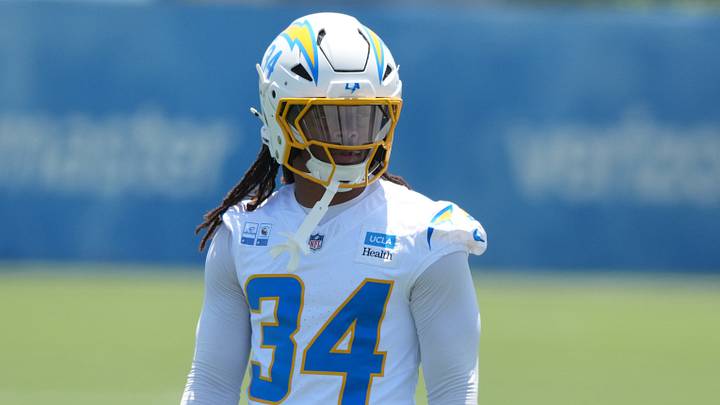
Coming into the season, we knew the Los Angeles Chargers were going to need to undertake a bit of a feeling-out process as they constructed the right mix of backfield opportunities for Omarion Hampton, Keaton MItchell, and Kimani Vidal.
After all, although the Chargers were supposed to have a proper backfield mix last season with Hampton and Najee Harris in the fold, that never truly came to fruition. Harris missed almost all of the season with a torn Achilles, and Hampton missed over half of the campaign with an ankle injury. Vidal fit well in Greg Roman's between-the-tackles run game, but it was unclear how Mike McDaniel would look to approach Los Angeles' ground attack.
There were thoughts that there might be a true split between Mitchell and Hampton, especially if the offense was working effectively and McDaniel was able to leverage the various looks to create variance within the Chargers' offense. So far this season, that latter point has been far from the case. The Chargers are 10th in the league in total rushing yards, but they're just 26th in average EPA per rushing play.
In general, the run game hasn't been successful, and although it was its most effective against the Seattle Seahawks when McDaniel split touches evenly between Hampton and Mitchell, that sort of strategy, over the course of an entire season, is simply a disaster waiting to happen.
Mitchell hasn't taken major touches at any point in his career, and his proper role, until evidence indicates otherwise, is as a complementary, change-of-pace back.
The Chargers need to figure out the right balance between Omarion Hampton and Keaton Mitchell in the backfield
There's two necessary qualifiers to this conversation before we truly dive in.
Firstly, the failings of the Chargers' run game, for the most part, don't fall upon the backfield. The interior offensive line has been immensely disappointing this season, and things have only gone downhill since Kayode Awosika and Trey Pipkins III went down in terms of interior protection. The play calling has also been somewhat confounding—Hampton has largely been confined to inside runs, while Mitchell has been pushed to the outside consistently, giving opponents an immediate edge on buckling down against whatever run attack Los Angeles is choosing to go with.
Secondly, Hampton has had some issues with ball security this season that, at least on the surface, justify an enhanced opportunity for Mitchell.
But Hampton was moving the chains consistently on Sunday against Seattle, averaging 5.0 yards per attempt and consistently using his physicality and acceleration to fight his way into and through the second level of the Seahawks' defense. So why did Mitchell, who was distinctly less effective over the course of the game, outpace Hampton in touches?
McDaniel stated as early as training camp that the Chargers were going to alter their backfield distribution on a game-to-game basis. But given the fact that Mitchell was still dealing with a minor injury at the start of the season, it's reasonable to assume that this enhanced workload was part of the plan all along. If it works, and helps keep Hampton healthy, then theoretically it's the right move.
But while Mitchell possesses the speed and agility to make him a solid fit in McDaniel's run scheme, he certainly doesn't have the same explosive-play ability or physicality that Hampton possesses. He, moreover, has not seen more than 59 touches in a single season during his short, injury-riddled career.
Taking snaps away from Hampton and giving them to Mitchell, at least to this extent, not only hamstrings the run game but also, over the course of the season, could put Mitchell at serious risk of injury. This run game, although unrealized to this point in the season, will be at its best when Hampton and Mitchell are both clicking, and Hampton is taking the bulk of the touches while Mitchell is operating as a serious complementary threat.
If Hampton's opportunities are reduced, this offense immediately becomes less potent than it already has been. If Mitchell goes out with injury, this run game may essentially be dead in the water.
It's a careful balance McDaniel has to strike—but it's his responsibility to sort out what that looks like if the Chargers are going to salvage this season in any sense of the phrase.
 Add us as a preferred source on Google