

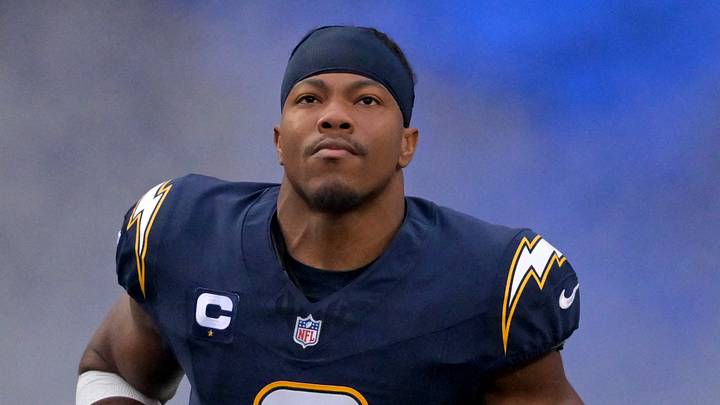
Well, it's certainly not the way many expected the trade deadline to go for the Los Angeles Chargers.
Joe Hortiz and the front office spent weeks leading up to the deadline telling national reporters that the team was hesitant to "give up" on the season, and that largely meant they weren't taking trade calls for any centerpieces of their roster. The thought, then, was that Los Angeles would either be completely stagnant at the deadline or it would move off a couple of its expiring contracts, like Donte Jackson and Dalvin Tomlinson, in order to recoup some late-round draft capital for this offseason.
What we ultimately got was a strange, in-between scenario.
The Chargers weren't completely inactive at the deadline—they moved Daiyan Henley, who's wrapping up the final year of his rookie deal, to the Denver Broncos in exchange for a 2027 fourth-round and a 2028 fifth-round selection—but that was ultimately the only move they made. Henley is gone, but Jackson, Tomlinson, Denzel Perryman, David Njoku, Kimani Vidal, and Keaton Mitchell all remain on the roster. So does Khalil Mack, for that matter.
If Los Angeles was truly that committed to keeping the leadership of this roster intact in spite of its 0-8 record, it's worth wondering why they would move Henley—to a division rival no less, where it'll need to face off against him twice a year for the foreseeable future.
But if you take the whole landscape of the trade deadline across the league, and the Chargers' own financial picture moving forward, into account, it starts to make more sense.
Chargers weren't willing to be sellers just for the sake of it—and the Henley deal must've been just enough to swing them
Again, this team made it clear that cornerstones of the roster moving forward, which likely include pieces like Tuli Tuipulotu, Derwin James Jr., and Ladd McConkey, weren't going to be available at the deadline. We also saw Los Angeles shut down interest in Justin Herbert from the Minnesota Vikings, for what it's worth.
So the determination had to come down to whether Henley was a part of that group—and whether any team would be willing to offer enough to make parting with his leadership a valuable proposition.
Henley burst onto the scene as a potential star at his position in 2024, posting 147 total tackles and tacking on three QB hits, one sack, and eight passes defended. He looked like he would claim the role of starting inside linebacker for the foreseeable future, and that if he could continue to progress in coverage and as a blitzer he would easily become a high-value defensive player for Los Angeles. Over the past two years, he's remained a valuable starter for Los Angeles.
But the other parts of his game just simply haven't come along. He's struggled heavily in coverage this season, allowing 19 receptions on 24 targets for 208 yards, and his overall value in the run game has been up and down since the end of that 2024 campaign.
Quite simply, what Henley has put on tape over the past year and a half wasn't enough, on its own, to justify the $15 to $16 million annually he'll be getting on his next deal. And the Broncos' package of two mid-round picks surpasses any sort of compensatory selection the Chargers would've gotten for Henley, especially considering the money they're (hopefully) going to spend to overhaul this roster this offseason.
This is all without even mentioning the looming extension for Tuli Tuipulotu and, beyond that, talks concerning Ladd McConkey and Joe Alt for 2028.
But what about the rest of the pieces, especially the depth ones on expiring contracts who could've been moved at the deadline? It's possible that the Chargers simply missed the ship on that one, as defensive tackle Davon Godchaux was moved to the Jacksonville Jaguars for a sixth-round pick on Monday, and most of the trades that took place on Tuesday were fairly high-profile.
But it's worth remarking that not a single cornerback, tight end, or running back was moved in the two days leading up to the trade deadline, and that begs the question—how many teams were truly in the hunt for depth pieces at those positions? And when it comes to Mack, the simplest answer is likely the correct one—he simply didn't want to move away from Los Angeles at this point in his career, and his no-trade clause (and tenure with the organization) give him the right to express that desire to the front office.
After the way this season has gone, there's very few places where it feels right, in the least, to defend the Chargers. But if Henley ultimately wasn't going to be brought back this offseason, getting maximum value for him, even with a division rival, was the right move. That doesn't mean it won't be frustrating to see him on Denver's defense over the next few years, though.
 Add us as a preferred source on Google