

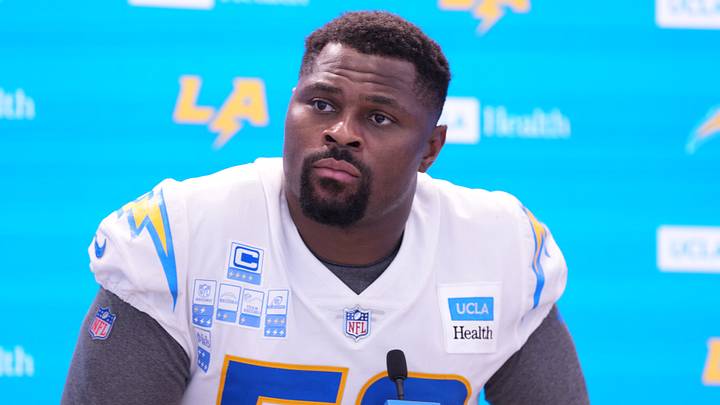
The Los Angeles Chargers face a difficult decision in the coming days ahead of the Nov. 10 trade deadline—unless the decision has already truly been made.
All the national reporting has indicated that Joe Hortiz and the Chargers have yet to take calls from other teams regarding trades for their players, and there's a real chance this roster remains intact through the deadline. It also seems, as of now, that moving Khalil Mack to a contender isn't something that's on the table.
Mack, first and foremost, has a no-trade clause in his contract—but even apart from that, he's earned the right to choose his fate. If he wants to end his career in Los Angeles, that should be the end of things.
But the Chargers have considerations beyond the immediate deadline they need to make. Mack will be 36 years old by the end of this campaign, and Los Angeles has done very little to convince him that returning for another year will yield a shot at a Super Bowl. It's a very real possibility, then, that Mack stays with the Chargers to finish out the season and hangs up the jersey at the end of the year.
This has been expected for a while—Mack seriously considered retirement for each of the last two offseasons before returning to Los Angeles on a one-year deal. But with Tuli Tuipulotu still not under contract beyond this season and their only primary option beyond that being Akheem Mesidor, the Chargers need to chart out a path to replenishing this room whether Mack is moved in the next week or not.
Khalil Mack's trade status is only the beginning of the Chargers' considerations in their edge rusher room
As good as Chris O'Leary's defense has been this year, especially relative to the other side of the ball for Los Angeles, the one place it's struggled has been in the pass rush. Through eight weeks, the Chargers are 24th in pressure rate and 26th in total sacks. Even with the same theoretical level of talent along the defensive line that Jesse Minter had last season, O'Leary has put up objectively worse results in the pass rush.
Tuipulotu is having somewhat of a down year compared to his breakout 2025 campaign, having posted just three sacks and 21 total pressures across seven games. Akheem Mesidor looks like a solid addition, and he's relative matching Odafe Oweh's production with the Washington Commanders at a much lower price point. But he's nowhere near ready to take on an alpha role in an NFL pass rush—he works well as a secondary or tertiary piece, and it's likely that's where his development will leave him over the next couple of seasons.
Perhaps Tuipulotu's contract value has come down somewhat, and that would justify the organization's inability to lock him down long-term to this point.
But the fact of the matter is that they have no other option—Tuipulotu needs to be signed long-term, and the longer Los Angeles waits, the more risk they run of losing him or having the price on his next deal be run up in free agency.
It feels unlikely, moreover, that the Chargers are willing to spend another top pick on a pass rusher in 2026. Their selection of Mesidor was the right swing at that spot in the Draft, but the landscape will be markedly different this offseason—and Los Angeles has other, more pressing needs to fill on both sides of the ball in the first and second rounds of this upcoming Draft. Any player it adds to the room in that capacity will likely be a third-round pick or later, meaning that Mack's departure would leave the Chargers with Tuipulotu and two young, developing edge rushers in the fold.
For what it's worth, Bud Dupree will be a free agent this offseason as well.
The Chargers, then, need to have a solid idea of what a room built around Tuipulotu and Mesidor can look like before they take another step forward, whether that involves trading Mack or not. Can Tuipulotu be the alpha long-term for this room, and what sort of edge rusher do they need to add to complement Mesidor as a secondary pass rusher?
If Mack returns for another season, then all is well. But that's not something the Chargers can necessarily count on, even if Mack decides to stay in Los Angeles through the end of the campaign.
 Add us as a preferred source on Google