

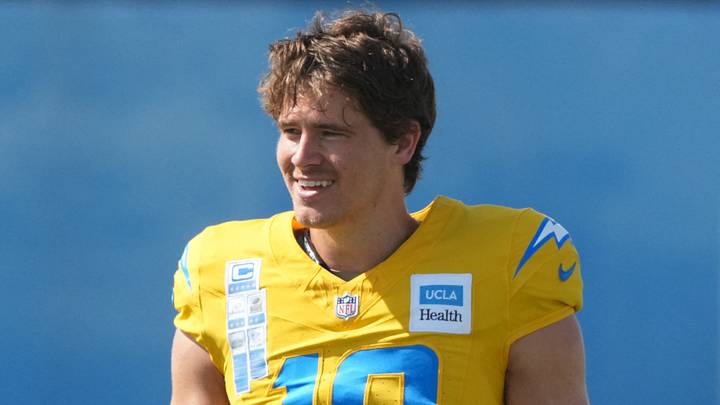
The Los Angeles Chargers took a gamble this offseason.
By bringing in Mike McDaniel, they moved away from the formula that had led the team to solid regular season finishes, but no playoff success, in the first two seasons under Jim Harbaugh. It was reasonable to think that Greg Roman had to go—although his scheme played into Justin Herbert's strengths, his ability to dial up complex and consistently dynamic routes for the team's receivers simply wasn't high enough to expect anything other than a middling offense out of him, even with solid protection.
The bet was that McDaniel's West Coast-style scheme could provide that. But that schematic shift also brought Los Angeles away from what Herbert does best, instead asking him to run much of the same anticipatory passing game that Tua Tagovailoa did in Miami and operate within an entirely different offensive structure.
The results, obviously, have been disastrous.
Unless there's a major turnaround over the remainder of the regular season, McDaniel should be gone this offseason. But that can't be the end of it for the Chargers.
As they chart a path beyond 2026, the focus—from the offensive scheme to the personnel choices—needs to return to maximizing the talent that Herbert has. There's simply no other path for Los Angeles to return to a competitive stature.
Justin Herbert is still the center of the Chargers organization—and any hope they have of righting this ship lies in him
Herbert, by the numbers, has been perhaps the worst quarterback in the league this season. Throug seven games, he's completed just 131 passing attempts for 1,398 yards and five touchdowns, tacking on 10 interceptions on top of that. His turnover-worthy play rate has skyrocketed to 6%, nearly triply his career-high, and it's clear that he simply isn't comfortable operating in the sort of offense that McDaniel is trying to run. He's forcing throws into non-existent windows, and his ability to read defenses and his progressions has taken a turn for the worse even as the season has gone on.
Of course, it's not possible to entirely extricate Herbert from the blame for how this season has gone. But it's worth asking, if McDaniel weren't here, would we expect Herbert to be among the league's top quarterbacks again? The answer is likely yes.
Herbert has been at his best that season (that is to say, remotely viable under center) when he's had to operate out of structure—when opposing pass rushers have closed in and he's been able to improvise and find his receivers outside of their scripted routes. An offense can't be built upon that, but it's clear that the anticipatory game is not one that maximizes Herbert's strengths, which are his arm, his accuracy, and his ability to avoid oncoming pressure.
The Chargers can fire McDaniel this offseason and start fresh with a more well-suited coordinator, sure. That needs to be the first decision they make, and it needs to be made with Herbert's comfort and future motivation in mind.
But the changes can't stop there. Los Angeles needs to get real, viable guards on the interior to shore up the team's protection in what will likely be a primarily gap-blocking scheme after McDaniel's departure. Even if the team returns to a scheme that Herbert is more comfortable with, the amount of pressure he's faced over the past two seasons is simply unacceptable. Los Angeles doesn't need to have one of the best offensive lines in the league, given Herbert's ability to avoid pressure on longer-developing passing plays, but they can't be among the worst and expect different results.
There also needs to be some major attention paid to the receiving corps this offseason. Quentin Johnston simply has not blossomed into the player the Chargers thought he could be, and Ladd McConkey needs a solid—perhaps even an alpha—deep threat, X-receiver to truly maximize his game underneath. Even if McConkey remains the Chargers' primary receiving threat going forward, that's a place where Los Angeles could realistically add a weapon and make Herbert's job immediately easier.
All of this is to say that, with the trade deadline approaching, Los Angeles needs to be thinking long and hard about what direction the organization goes from here. Even if Joe Hortiz doesn't budge from his stance on not stripping back the roster at the trade deadline, there needs to be a real path forward—and it needs to be focused on maximizing Herbert's talents, not addressing the deficits in his game with another pure schematic overhaul.
 Add us as a preferred source on Google