

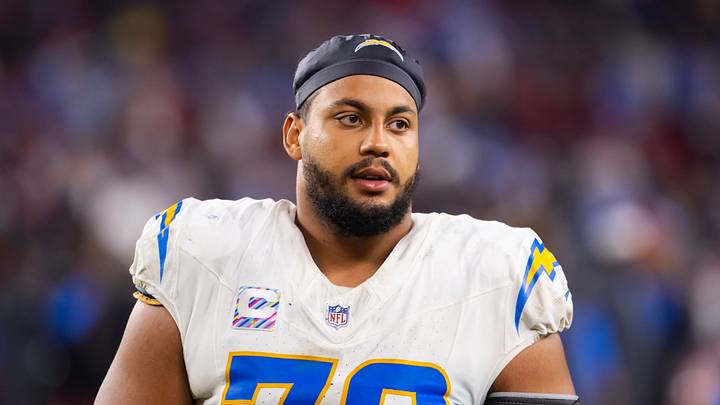
The Los Angeles Chargers, especially this season, tend to exist a team of hypotheticals. If Justin Herbert had the right protection and tools around him, he could be a Super Bowl-worthy quarterback. If Mike McDaniel had the same caliber of receivers he did in Miami, perhaps the Chargers offense would look more dynamic.
The combined viability of Rashawn Slater and Joe Alt at the Chargers' tackle spots is quickly becoming one of those if scenarios. Alt has missed just a couple games this season with what seems to be a relatively minor neck injury, but even if he returns in Week 8, that puts him having missed 14 of his last 24 games since a completely healthy rookie season. Slater, meanwhile, remains on the IR with a high ankle sprain—and that comes after missing the entirety of last season with a torn patellar tendon.
Since drafting Alt with the fifth overall selection in the 2024 NFL Draft, the Chargers have seen only one stretch of truly healthy play for their bookend tackles (in 2024), and Los Angeles was a middle-of-the-pack team that year in terms of sack rate. Both Alt and Slater, when healthy this season, have also had their fair share of struggles.
The idea of moving Slater to guard—both to maximize his efficiency in pass protection and to preserve his health—is one that's been floated in Chargers circles over the past year or so. It makes sense that, with another relatively significant injury and the emergence of Travis Burke as an option at tackle, it would pop back up.
But the Chargers, for now, simply need to wait and hope that Slater can get healthy. The best version of this team is with both Alt and Slater holding down the tackle spots, and until it's proved definitively otherwise, the Chargers' best move is to hold the course.
The Chargers need to hope that Alt and Slater are their answers at the tackle positions—if they're definitively not, that's a different story
Even apart from their respective injuries, Alt and Slater have had their fair share of struggles this season. Alt has been excellent in pass protection outside of a couple isolated matchups, allowing just three pressures and zero sacks across 130 pass-blocking snaps. But he's struggled with penalties to this point in the season, racking up six separate flags through not even four complete appearances.
Slater, meanwhile, carries the more concerning burden. His return to an All-Pro level talent was never guaranteed after that serious of an injury, and he performed below his mark across his first four games of 2026, allowing eight total pressures and one sack on just 152 pass-blocking snaps.
When these players are available and at their best, they're among the top tackle duos in the league. When they're not available, Los Angeles is left paying a combined $32 million to have a pair of rookies play their two most important positions along the offensive line. That number, when the Chargers are forced to either extend Alt or pick up his fifth-year option in 2028, could extend as high as $55 million.
Los Angeles does have an out on Slater's contract in 2029 that would incur just $5.8 million in dead cap—but that's a bridge we'll cross when we get there.
For now, moving Slater to the inside would theoretically be an option to preserve his availability. But neither of their other tackle options—Trey Pipkins III or Travis Burke—have proved themselves as truly desirable tackles in an NFL offense. Pipkins, besides being on the injured reserve, is a viable swing tackle, but his inconsistencies in pass protection when he's gotten full-time reps at the position have been highly concerning.
Burke, for his part, has shown a lot of promise as a long-term swing tackle and perhaps a replacement for Pipkins. But it's not yet time to anoint the rookie—who allowed six pressures and a sack in his two weeks as a starter and was consistently worked to the outside by quicker pass rushers—as the Slater replacement of the future. There's still a lot of work to be done there in terms of his agility and ability to recover in those sorts of situations.
It's reasonable to be concerned about Slater's level of performance over the first portion of the season. But he didn't play for an entire year, and it was always going to take time for him to regain his composure and consistency at a position as demanding as left tackle.
If he looks this way through the end of the season upon his return from injury, that's a different conversation. But Los Angeles invested $114 million in Slater to be this team's anchor across from Alt. It's far too early to abandon that plan for the sake of solving an already broken interior offensive line.
 Add us as a preferred source on Google