

The Los Angeles Chargers, needless to say, are going to have their work cut out for them this offseason.
At 1-9, this isn't a roster than can simply be 'run back'. There are major holes to be filled on both sides of the ball, and Joe Hortiz and the Chargers' ownership need to be willing to leverage all of their nearly $100 million in projected cap space to get that done.
Of course, though, the looming extensions on this roster loom large over those eventual free-agent decisions. Tuli Tuipulotu, who's having a bit of a down year production-wise but emerged as a true alpha in the pass rush in 2025, is still set to hit free agency this offseason. Daiyan Henley is nearing the end of his contract, and both Ladd McConkey and Joe Alt will see pay raises in 2028. And that's without even factoring in the leap to a $71 million cap hit Justin Herbert's contract will take in 2028, barring any sort of restructuring.
The Chargers have some major moves to make externally. But before that gets done, Tuipulotu needs to be their main contract priority, and if they can keep him around or under $25 million annually, that will be a major victory.
From there, Tarheeb Still needs to be the next major internal priority. He's simply too important to the secondary, even if the Chargers are able to add another top corner through the draft, for it to be otherwise.
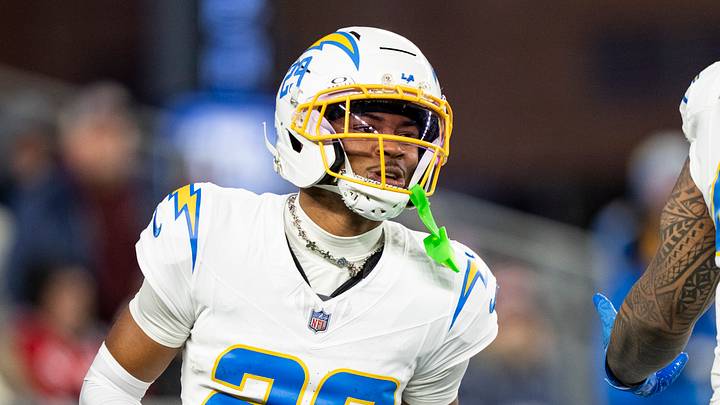
Tarheeb Still needs an extension—even if it doesn't come until the end of 2027
Under Hortiz, the Chargers haven't been known for committing long-term money to their secondary. They let Benjamin St-Juste walk this past offseason, likely in hopes of him factoring into their compensatory pick formula, and their two primary corners, Still and Cam Hart, are former fifth-round picks on rookie contracts.
In theory, Los Angeles could devote that money elsewhere, depending on Hortiz's scouting abilities to replenish the cornerback room through depth signings and the middle rounds of the draft. But with Still out on Sunday against the New York Jets, we saw the danger of having a secondary without its true cornerstone in the fold.
Now, the Chargers lost that game primarily because of their inability to stop the run, which obviously doesn't come down to Still's absence. But with Donte Jackson and Hart as Los Angeles' two starting corners, there was a notable drop-off in performance from what we've seen to this point in the season. The Chargers allowed Geno Smith to complete 17 of his 21 passing attempts for 176 yards and three touchdowns—and both Jackson and Hart, alternately, were overmatched trying to deal with Garrett Wilson and the Jets' complementary pass-catching threats.
If Still had been available, they could've trusted him to handle that physical matchup while using Hart and Jackson more effectively in complementary roles. And if they're able to add another viable starting option at the position in the draft after Jackson's departure this offseason, that puts Hart in an even more insulated position as the third rotational cornerback in that room.
But none of that long-term vision for the secondary works if Still isn't locked down long-term. Even if the Chargers add, say, Leonard Moore in the top-five of this upcoming draft, pairing him and Hart while letting Still walk isn't a viable option for long-term success.
Having Still on a deal somewhere around the $16 or $17 million annually that Riley Moss and Christian Benford commanded on their recent extensions while having either a veteran free-agent cornerback or a player like Moore on a rookie deal paired alongside him is.
This isn't to say that the Chargers can't extend Hart as well. But Still has developed into the true cornerstone of this room over the past two seasons, and even if Los Angeles can't get a deal done this offseason, letting him walk simply isn't an option in 2027.
 Add us as a preferred source on Google