

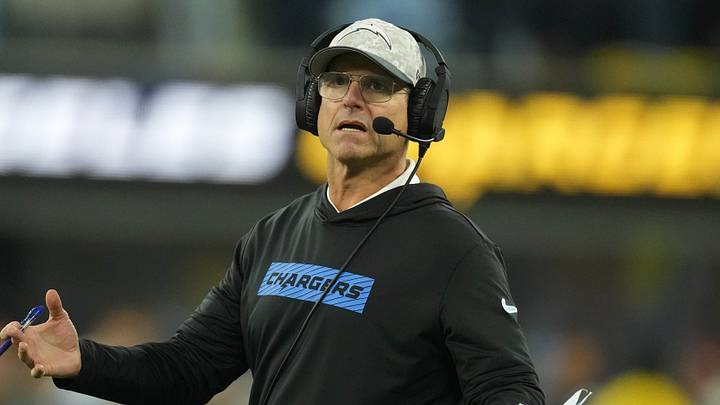
The Los Angeles Chargers have officially started the season 0-2 with a loss against the Las Vegas Raiders.
Although things looked improved in the first half, especially on the offensive side of the ball, the miscues, penalties, and flat out incompetencies that plagued the Chargers in Week 1 reared their ugly heads again. With a chance to take the lead in the fourth quarter, Los Angeles fumbled on back-to-back downs to turn the ball over to Las Vegas, only to blow coverage in the red zone on a play fake and give up the touchdown that put the game on ice.
With a gauntlet of matchups looming between Weeks 3 and 10, it's hard to see how Los Angeles digs its way out of this barring a miraculous run—something this team has not shown us it's capable of at this point. Perhaps there will be room for optimism tomorrow, but it's mostly doom and gloom for now.
8 takeaways from the Chargers' Week 2 loss to the Raiders
1. The Chargers' playoff hopes just took a massive, massive hit
It was always going to be an uphill battle for the Chargers to match the 11-win total they reached in their first two seasons under Jim Harbaugh. But the thought was that, as long as they could enter the playoffs with a viable offense and a solid offensive line, they would stand a real chance at earning their first playoff win of the Harbaugh era.
That reality is seriously in doubt now that they've descended to 0-2. The AFC West looks to be as competitive as ever, and the Chargers will kick off the hardest stretch of their season next week with a matchup against the Buffalo Bills. After that, they'll face both other divisional rivals, both NFC Championship Game teams from last season, and a pair of difficult defenses in the Houston Texans and the Baltimore Ravens. If they can exit that stretch with, say, five wins, they'll have a shot to come out strong in the back half of the season. But that feels like a far-away reality given how we've seen them play so far.
2. Thinks looked somewhat improved, but Justin Herbert is going to need time to find his footing in this offense
In the first half, the offense was able to gain some actual traction—an inspiring sight compared to what we saw last week. But Herbert finished the game completing just 15 passes for 192 yards, one touchdown, and two interceptions, and the Chargers were plagued by penalties and mistakes in the second half that made it impossible to truly gain any momentum.
There's a perspective from which you can chalk this up to simply an adjustment to Mike McDaniel's scheme. The ball clearly isn't coming out as quickly as it needs to, and there are other wrinkles that aren't being executed well on a down-to-down basis. These are things that can be fixed with time, but it's hard to imagine a worse start to the season given the expectations we had during the offseason for what this offense could look like from the jump.
3. Chris O'Leary didn't adjust in the way he needed to, and the Chargers suffered for it.
To O'Leary's credit, the defensive line looked vastly improved. Although we don't have the final pressure numbers yet, I'll wager to say that O'Leary's new and varied looks along the front seven opened the door for the Chargers to create vastly more disruption in the backfield than they did in Week 1 against the Cardinals.
But this time the secondary failed to stop the deep shot, and there were numerous breakdowns in communication that led to game-changing plays for Las Vegas. Some of this should fall upon the players, including Genesis Smith and Cam Hart, but the clear lack of preparedness and schematic continuity among this defense fall squarely at O'Leary's feet.
4. Chargers need more out of Quentin Johnston— flat out
Johnston finished the day with one reception for seven yards. He finished last week with two receptions for 17 yards. He simply hasn't been a real factor in this offense, and that's something that desperately needs to change.
A large part of this definitely falls upon the offense's overall lack of cohesion. Is there any point where you've truly felt as though this offense was capable of unleashing and capitalizing upon a downfield threat consistently? But the Chargers showed faith in Johnston this offseason by picking up his fifth-year option, and this passing game doesn't fully work if he's not creating separation in the deeper parts of the field and, at the very least, forcing the defense to pay attention to him on a down-to-down basis.
It's not entirely Johnston's fault, but he needs to heat up if this offense is going to find its footing.
5. The offensive line still has major questions heading into Week 3
Apart from the three separate false start penalties on Joe Alt and a couple of isolated breakdowns in protection, the Chargers' offensive line actually looked somewhat solid during this game. They were successfully making space for the run consistently in the first half, and both Jake Slaughter and Kayode Awosika showed some major strides in pass protection.
But Awosika left the game and was replaced by Trevor Penning, and what they had going in run protection clearly wasn't enough to allow the offense to consistently hold its momentum deep into the second half. It's not the biggest concern this team has, and that's a refreshing thought. But things certainly aren't solidified on that front, either.
6. David Njoku and Charlie Kolar injuries are potentially significant for this offense
Njoku was carted off the field with a knee injury, and Kolar snuck out through the tunnel when Awosika went off the field as well. We won't have updates on either until tomorrow, and the Chargers have the resources in Kolar and Oronde Gadsden II to overcome a short absence for Njoku. But if both players are out, McDaniel is immediately without a pair of major schematic and blocking weapons for this offense.
The Chargers currently have Patrick Herbert and Evan Svoboda on the practice squad. Expect one or the other to be elevated if even one of these TEs needs to miss time.
7. Cam Hart had possibly the worst game of his career—where do the Chargers go in the secondary?
Won't have official numbers here until tomorrow, but anyone watching the game knows that Cam Hart had, well, a rough day. He was targeted numerous times early in the game on shallow, in-breaking routes by Raiders QB Kirk Cousins, he extended a pivotal drive for Las Vegas with a hands to the face penalty, and the breakdown in coverage that led to the Raiders' final touchdown was at least partially his fault.
The Chargers let Benjamin St-Juste walk this offseason, and they're left now with just UDFA Rodney Shelley (who was bodied by Cody White in the end zone during this game) to rotate in at outside corner. The depth of this cornerback room is somewhat concerning, and this bad of a game from Hart doesn't do much to inspire confidence.
8. Silver Linings: Teair Tart, Omarion Hampton, and Tre' Harris
Ok, I lied—just a little bit of optimism here. But I'll keep it brief.
Teair Tart had a monstrous game, working his way into the backfield against Las Vegas' interior protection numerous times and making life hard on Cousins. If he can perform like this more consistently, he might be the key to the Chargers unlocking the full breadth of their pass rush this season.
Hampton, despite the fumble that effectively ended the game for the Chargers, continues to look gritty, strong, and explosive in the run game. He's a star in the making, and Los Angeles simply needs to put together the offensive infrastructure to capitalize off of it.
Tre' Harris also had the longest reception of his career, and it will be interesting to see how he gets involved in the offense over the coming weeks.
 Add us as a preferred source on Google