

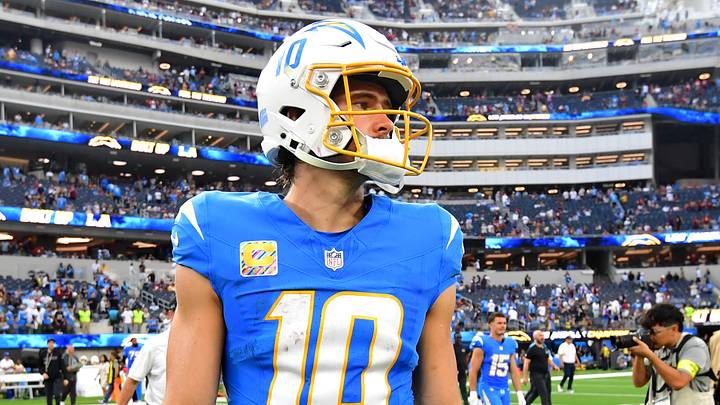
The Los Angeles Chargers certainly weren't in top shape heading into this game. After starting the season 0-4, this definitely didn't feel like their best opportunity for a win.
But the defense held its own over the course of the matchup, only truly ceding ground when the offense left it in disadvantageous situations in the second half, and the offense even suprisingly found some momentum with the large bulk of its playmakers out of the fold. The Chargers, in the end, dropped the matchup to the Denver Broncos 17-20.
But all things considered, it was a more encouraging performance than you otherwise might've expected to see from a severely depleted Los Angeles team. Taking away any broader conclusions from this game will be tough given just how much of the core of the roster was missing. Perhaps the bye week will present an opportunity for a true re-evaluation of this team's trajectory over the remainder of the campaign.
For now, we'll try to keep things limited—here are five immediate takeaways from today's loss against Denver.
It's time to start looking for silver linings as Chargers drop to 0-5 on the season
1. Chris O'Leary is still the major highlight of this season for Los Angeles
Yes, this was a struggling Denver offense heading into this matchup—so much so that Sean Payton was forced to take over play-calling duties after ceding them this offseason to Davis Webb. Yes, it doesn't matter much how well the defense plays if the offense can't find a way to move the ball and hang onto it when it counts.
But the Chargers held the Broncos to just 224 total yards of offense while missing both Derwin James Jr. and Donte Jackson, and that tracks the performance the unit put up against the Seattle Seahawks and Buffalo Bills as well. Nix was heavily limited by the Chargers' coverage schemes, completing 16 of his 27 passes for just 123 yards and a touchdown, and the pressure was there consistently from Los Angeles' defensive front over the course of the matchup.
If there's anything that can be gleaned from this recent stretch of games, it's that Chris O'Leary has found his stride as a defensive play caller, and although there are still some coverage busts, he's accomplished quite a bit with the tools he's had at his disposal. This matchup was no different, and he should be commended for that.
2. Tre' Harris' injury is (obviously) a major blow to this room—even if McConkey and Johnston return quickly
The Chargers entered this game with Ladd McConkey, Quentin Johnton, Brenen Thompson, and KeAndre Lambert-Smith—four of their top six receivers at the start of the season—essentially out of fold. While McConkey was technically active, it was made clear that he likely wouldn't see any sort of significant snap share as he continued to rehab his foot injury.
Tre' Harris was, then, the Chargers' only real receiving threat. He put up just two receptions for 16 yards over the first portions of the game before going out with an apparent hamstring injury in the second half. Although there wasn't much going for the offense before Harris exited the game, that was essentially the death knell for Los Angeles.
Even if McConkey and Johnston are both active for next week, Harris has been the only consistent explosive-play threat this offense has been able to identify and leverage through the first five weeks of the season. If he's forced to miss any time, things could quickly get even uglier than they already are.
3. Chargers' backfield finds a sustainable balance vs. Broncos
There was a lot of debate last week against Seattle when Keaton Mitchell surpassed Omarion Hampton in touches, and rightfully so. The Chargers' run game has, plainly, been sub-par this season, and limiting the true opportunities for its most explosive back felt like a real mistake. At the same time, though, the variability and versatility of this backfield should be a major asset to Mike McDaniel, so it's important to see things being mixed up on a game-to-game basis.
Hampton saw 14 carries in this game, while Mitchell saw five, and Kimani Vidal saw eight. That in and of itself is an encouraging adjustment. But we also saw those runs go to all different parts of the field. With Hampton taking more outside opportunities and both primary backs being worked into the passing game as well.
The Chargers ultimately amassed 155 total rushing yards on the day—a solid result given the odds this offense was up against.
4. This O-line deserves its flowers, but the experience deficit was simply too much to overcome
Things fell apart towards the end of the game, with Herbert getting sacked multiple times to ultimately put the matchup out of reach. But let's quickly put things in perspective here. Los Angeles was entering this game with four rookies starting along the offensive line—Jake Slaughter at center, Alex Harkey and Travis Burke at right and left tackle, and Logan Taylor in at left guard. Both Harkey and Taylor were sixth-round selections in this recent draft.
Is it in an indictment of the Chargers' strategy for re-shaping their O-line depth that we were even at this point in the first place? Almost certainly.
But for the vast bulk of this matchup, a line with little to no cohesion or NFL experience kept the offense mostly clean. There were very few penalties, and this wasn't a particularly easy matchup against a strong Broncos defensive front.
At the end of the day, the talent and experience gap was simply too much to overcome.
5. Akheem Mesidor is very much a star in the making—and he looks better every week
There were real questions about the advancement we could still see from Akheem Mesidor when he entered the league. After all, he is already 25 years old, and he doesn't necessarily have the raw power you might expect to see in a prospect of his caliber. But he has the speed and the explosiveness to make a consistent impact when paired with Khalil Mack and Tuli Tuipulotu in Los Angeles' pass rush, and we saw that again against Denver.
He posted eight tackles, one sack, and a forced fumble (if you want to credit him on the Tuipulotu punch-out) in this game, and it seemed like you could constantly feel his presence working his way into the backfield and disrupting Nix in the pocket. It may be a while before we see how he can function as a primary pass rusher without Mack in the fold, but the early returns are very promising.
 Add us as a preferred source on Google