

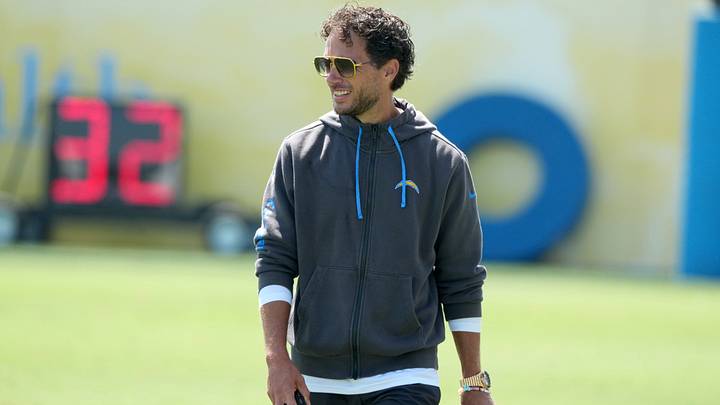
At 0-6, not much has changed for the Chargers over the BYE week. HC Jim Harbaugh announced yesterday that OC Mike McDaniel will remain the teams' top play caller. While his job status may have been up in the air last week, it seems like he'll get a few more games at the very least now.
The Chargers are more than likely out of playoff race as it currently stands. No 0-5 team has ever made the playoffs, let alone at 0-6. So for McDaniel (and the rest of the Chargers coaching staff), it's about getting better results from week-to-week. If he wants any chance at being retained next season, the offense has to have some level of verifiable improvement.
How can the Chargers offense improve after their BYE week?
Getting healthy
Joe Alt (neck) returned to practice during the BYE week after he received a positive update from a specialist. It seems like he'll be back for the Chargers this week. He was not listed on Wednesday's injury report. WR Ladd McConkey is in concussion protocol, but should probably clear it by gameday. Tre' Harris (hamstring) may also be on the list of reinforcements. LG Kayode Awosika and WR Brenen Thompson did not practice Wednesday, but the Chargers are at least getting a few key guys back.
In Week 10, Rashawn Slater is eligible to return from IR. Nothing is promised there, but that's another reinforcement—although we'll see where the team is by then record-wise. The Chargers could get some other players back over the next few weeks.
These returns won't solve the core problems that currently exist with the offense. But they could at least make McDaniel's unit have a higher floor for performance than it currently does.
A less obvious run game approach
To me, the issue with the run game has been less the split between the three backs and more their usage. Using PFF's charting of run direction so far this season, a trend emerges. With Omarion Hampton, the Chargers run to the tackle/end 48.1% of the time. With Keaton Mitchell, that number is nearly 20% higher at 67.4%. And defenses have played like they know an outside zone concept is coming with Mitchell vs. a a run inside for Hampton.
Taking this a step further, Hampton has a 23.8% stacked box rate. They load the box when Hampton is on the field knowing a run is probably coming. For example, Hampton played just 20 snaps vs. Denver. But he carried the ball 14 times in those snaps. They've been pretty hesitant on using him in the passing game.
It should be said that it will probably be difficult to get the run game going in any context. Take a look at the interior offensive line if you want to find out why. But a big problem on top of that is that OC Mike McDaniel has not really put Hampton in ideal spots for production. It's hard to beat the other teams' defensive trenches in the run game while you're getting in your own way.
Lean into Hampton's receiving and YAC ability. We don't need to bounce every Mitchell run outside. Even with Kimani Vidal right now, 2/3rds of his runs go right up the gut.
There probably won't be a miraculous rebound for the run game. But the Chargers are making it very easy for defenses to stop them within the margins they can control.
"Simplification"
Last week, Jim Harbaugh talked about simplification when discussing potential changes for the Chargers' offense. Whether that's shortening play calls or having fewer actual calls in the playbook, it might be necessary. McDaniel's offense has really struggled with timing and structure.
The Chargers were second in the league in penalties with 52 heading into the Kansas City game. Even after a BYE week, they still remain in the league's top 10. False starts were a massive problem earlier in the year. In recent weeks, the Chargers have struggled with illegal shifts and motions. Harbaugh said that was a focus after the Kansas City game.
Players routinely line up in spots they're not supposed to be in, even on successful plays. It's hard to operate any coherent offense like that.
McDaniel has to find a way to be able to communicate the playbook more effectively to his players. If that doesn't change, the Chargers' startlingly bad offense will only continue to regress. It's not the only reason, but it's a key factor in the sheer amount of offensive Chargers players that have taken a step back this year.
Let Herbert be Herbert
Whether it's the second half against Seattle or the third quarter vs. Denver, the best of Herbert this season has been his improvisational playmaking. Herbert using his legs to pick up yards on undesigned runs has kept a few drives alive. The Chargers have found some success when they've scaled back the offense a bit and kept it more vanilla.
The Tua Tagovailoa Miami-based system Herbert is currently playing in will not change. But it's up to both McDaniel and Herbert to find more uses for him as a playmaker with his legs (and arm) than they have to this point. The point and click offense does not work when the weapons and offensive line are not currently league average.
Catch the ball when it's thrown in your direction
Perhaps the last point is a bit facetious, but it's true. The Chargers rank 27th in drop percentage through seven weeks (7.1%). Through six weeks, they were 30th in yards lost to drops (145). Quentin Johnston and David Njoku both ranked in the worst 30 pass catchers in terms of EPA lost to drops. TE Oronde Gadsden II was not far off the list.
This is not to single out any player in particular, but the plays do have to be made when they are there to be had. It adds to the list of ways the offense continues to get in their own way.
 Add us as a preferred source on Google