

The first day of legal tampering in the NFL is always the busiest, but not for the LA Chargers. Just like a year ago when they found themselves in a similar cap situation, the Chargers stayed relatively quiet and made moves around the fringes.
After signing the likes of Tyler Biadasz and Alec Ingold before free agency, as well as re-signing Khalil Mack and Teair Tart, the Chargers signed tight end Charlie Kolar, guard Cole Strange and re-signed depth offensive lineman Trevor Penning. Those were the only reported deals on Monday.
Meanwhile, several prominent internal free agents and free-agent targets skirted the Bolts. General manager Joe Hortiz typically doesn't operate atop the free-agent market, but there was a baseline expectation that he would do something somewhat significant after the Chargers fell short in the NFL Playoffs again.
Every move the Chargers did, or didn't, make has an impact on those on the roster. Some players will naturally benefit from the team's early mindset, while others may suffer.
2 Winners and 1 loser from Chargers' first day of legal tampering:
Winner: Tuli Tuipulotu
Bud Dupree signed a four-year, $100 million contract with the Washington Commanders, leaving Tuli Tuipulotu and Khalil Mack as the two main edge rushers on the Bolts' roster. Time will tell if Kyle Kennard steps up and makes his name known in 2026.
One thing is for certain, though: by not paying Oweh, the Chargers are almost certainly guaranteeing they will pay up for Tulipulotu at some time in the near future. The 23-year-old edge rusher is extension eligible this offseason and it would behoove the Chargers to get a deal done now both to avoid it lingering into the season and to avoid Tuipulotu's price going up in free agency after the 2027 season.
Tuipulotu will almost certainly get a contract similar to that of Oweh's in the four-year, $100 million range. To some that may seem like the wrong choice, but the Chargers are right to invest on the younger edge rusher who makes more of an impact on every down.
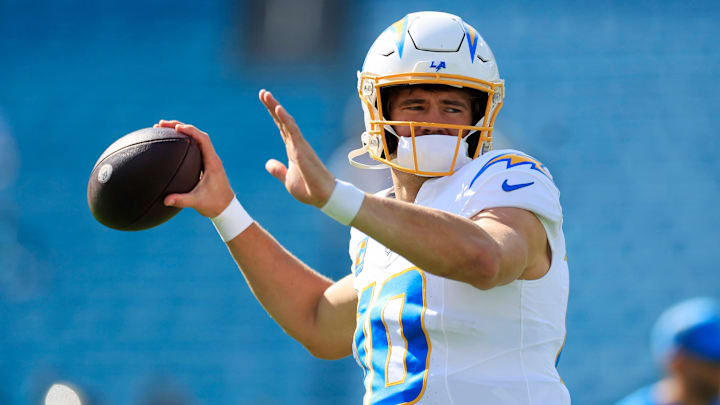
Loser: Justin Herbert
For the second offseason in a row, the main priority was sold as protecting Justin Herbert. Last year, the Chargers didn't upgrade from Bradley Bozeman or Zion Johnson after their bad 2024 seasons and only brought in Mekhi Becton on a deal that ultimately ended up hurting the team.
Johnson proved them partially right with a bounce-back year that may not have been elite, but was durable and serviceable. So what did the Chargers do? Let him walk at a price that was lower than expected.
All the Chargers have to show for their Herbert protection plan is Biadasz, who is a fine and serviceable player, but was the third Belle of the Ball as far as free-agent centers were concerned this offseason, Penning, and Strange. With the free-agent guards drying up quickly, the Chargers have to act quickly to avoid the same fate in 2026.
Winner: Omarion Hampton
The interior offensive line may not look promising from a pass protection point of view but one thing is clear: the Chargers want to run the football. That is a core principle of Mike McDaniel's offensive scheme and the Chargers' early moves were a reminder of that.
Fullback Alec Ingold and tight end Charlie Kolar are going to make Omarion Hampton's life so much easier in the backfield. Ingold gives the Chargers their first truly impactful fullback since Derek Watt, while Kolar was quietly one of, if not the, best blocking tight ends on the free-agent market.
Heck, even Strange is a serviceable run blocker, although he is such a bad pass blocker that it would be a disservice if he is actually starting for the Chargers. For better or worse, the Bolts are prioritizing the run and that helps Hampton in year two.
 Add us as a preferred source on Google